Show notes
- Pictures of Chesterfield’s crooked spire
- Chesterfield Parish Church
- Changing Faces
- Changing Faces on Instagram
- Website: Overcome Compulsive Hoarding
- Become a Dehoarding Darling
- Submit a topic for the podcast to cover
- Questions to ask when dehoarding: https://www.overcomecompulsivehoarding.co.uk/podquestions
- Instagram: @thathoarderpodcast
- Twitter: @ThatHoarder
- Mastodon: @ThatHoarder@mastodon.online
- TikTok: @thathoarderoch https://www.tiktok.com/@thathoarderoch
- Facebook: Overcome Compulsive Hoarding with That Hoarder
- Pinterest: That Hoarder
- YouTube: Overcome Compulsive Hoarding with That Hoarder
- Reddit: Overcome Compulsive Hoarding with That Hoarder subreddit
- Help out: Support this project
- Sponsor the podcast
Subscribe to the podcast
Transcript
Welcome to the Overcome Compulsive Hoarding with That Hoarder podcast. I am drowning in stuff and trying to find a way out. Listen as I explore the issues and delve deep, as somebody profoundly affected by hoarding disorder.
Find out more, including links to subscribe to the podcast and all my social media, at overcomecompulsivehoarding.co.uk.
Finally, I am not a doctor, I’m just a hoarder doing her best, so do seek professional support if and when you need it.
Hey, how are you? I am having a bad day, endometriosis, pain-wise. So that’s quite sore. But otherwise… I don’t know… struggling a bit, which actually led to the topic of this episode. So I guess something good came out of it! We’ll see anyway.
So today I am going to talk about a church spire, and obviously how it relates to hoarding and mental health and how we feel about ourselves.
And then I am going to read a listener secret and talk about that. And then I have a top tip for you.
But first of all, I want to thank those of you who voted on the new theme tune. There were a mix of views, but there was one pretty clear winner. So I am really pleased about that.
So I want to talk to you about a church. It was built in the 13th century, so in the 1200s. And then in the 1300s, a spire was added.
And it’s a church in a town in the north of England called Chesterfield.
And over the years, this church, which is the biggest church in the county of Derbyshire, the spire, which is the big, tall, sticky-outy, pointy thing at the top – I’m sure there’s a better way to describe that.
But over the years, the spire has twisted round and slightly bent over.
And it’s become quite famous. That’s what some people know Chesterfield for. If you’re going past on the train, you can see it. If you’re in the town, you can see it. I’ve seen it a number of times.
And there are a whole lot of stories about Chesterfield’s crooked spire.
Quite a few are devil related. Some say that the devil was flying past and wanted to have a rest, so sat on the spire and its tail twisted it.
One says that the devil’s hooves needed shodding. And a Chesterfield blacksmith was persuaded to do this, but he was so nervous because he was putting horseshoes on Satan himself, that he missed with his hammer and he drove a nail into the devil’s foot. And he jumped up and hopped around and knocked the spire in the process.
The story about the crooked spire that I heard when I visited was that one day there was a wedding in the church and the bride was a virgin. And it was such a novelty that even the spire twisted around to have a look.
And the ongoing joke is that it will right itself should another virgin ever get married in Chesterfield’s church.
So obviously those are quite fun folk stories about it.
The real story seems to be a mixture of things. That the spire was originally built out of wood, and then in, I think the 1700s, some of that was replaced by lead to be more durable, but the lead is obviously heavier. And something about like the sun on one side of the church expands it. So it twisted.
There are different theories. Another, I don’t know if this is a folk tale or a genuine theory, but another of the theories was that during the Black Death, during the plague, all of the skilled tradesmen died. And so the rest of the spire had to be built by unskilled carpenters, I guess.
So there’s lots of stories around Chesterfield and its crooked spire. And Chesterfield has embraced it. It’s embraced the spire.
It looks unusual. But rather than say, oh, this is embarrassing. We’ve got to fix it. Or rather than say, this is shameful, let’s remove the spire. Instead, the crooked spire is on a lot of the imagery for businesses and organisations around the town. People go to Chesterfield specifically to see the crooked spire.
And I read an article about it the other day, and it made me think about how if the church had a regular old straight spire, it would still be nice to visit, but it wouldn’t be known and loved beyond visitors and churchgoers.
It would be a nice enough church that you might pop into if you were in town. But it wouldn’t be, oh, you’re going to Chesterfield, don’t forget to go and visit the church.
And this came to me when I was feeling very down on myself, very self-critical, very like a failure, very broken. Like I’m not adulting properly. I’m not humaning properly. I’m just failing.
And because I read the article about the crooked spire at the same time as having these feelings about myself, I realised that there’s a kind of parallel there.
The crooked spire is weird. It's kind of an architectural failure. It is damaged. It is not 'spiring' very well. Share on XThat the crooked spire is weird. It’s kind of an architectural failure. It is damaged. It is not spiring very well.
And yet it stands 266 feet tall, I think, if I’m remembering correctly. And it stands proud.
And people love it for its imperfections. They don’t write it off because of its imperfections.
If anything, it’s better known. It’s certainly more photographed than a perfect spire probably would have ever been.
And there’s something about the resilience of the spire as well. It’s been there since the 1300s. And it’s still there. It’s still there, being wonky and gorgeous. And it’s charming.
It’s charming. It’s lovely, it’s a beloved spot in the town.
And we are all… every human is imperfect. Every human has flaws. And sometimes, if we’re struggling a bit, we see our own imperfections and flaws so strongly, so much more loudly.
We can’t see beyond what we’re failing at, or what we are doing badly.
We often don’t see the people we love in that way. We see their flaws and get a warm, fuzzy feeling.
We see their weirdness and ignore it, or love that they can express themselves in that way.
But we have this double standard quite often about ourselves, where we’re uber critical.
And that has a massive impact on our self-esteem, our degree of self-acceptance.
This has a massive impact on our self-esteem, our degree of self-acceptance Share on XAnd that, certainly I find with myself, varies depending on, I think, my mental health in general. If my mental health is a bit wobbly, or if my life is a bit stressful, I’m a lot more likely to be super critical of myself.
Whereas if I’m feeling quite good in general, I can overlook or even enjoy some of my flaws from time to time.
But this is all the stuff that makes us unique, even if it doesn’t fit with what we’re told we’re meant to be doing.
You know, as somebody who grew up gay in a world where that was really not okay, that was something that I very firmly… it wasn’t even that I believed it was wrong, it was that I knew it was wrong. I knew this was a thing in me that was bad.
And as a teenager, that was how I felt. It was something that must be eliminated at all costs, because it was bad. I was bad.
Now, as a grown adult who came out many years ago and feels fine about it, this is part of me that I see I was getting the wrong information about when I was 15.
I see that the world was that little bit more hostile then. I’m not saying it’s not hostile to LGBT people now. I wish it wasn’t, but it is.
But because the world has shifted a bit, and also I’ve shifted a lot in my own understanding of that, and in the people I surround myself with, and the messages I choose to consume and the messages I choose to ignore, something that used to be, for me, absolutely unacceptable in myself, is now something that not only is fine in myself, it’s something that’s positive and good and an absolute bonus in my life.
And that’s something that the norms of society, certainly in the 80s and 90s, but still to some degree, is off kilter.
It is not aligned with what the world tells you you’re going to be or you should be.
And yet it’s something that’s different, but really good, really positive.
And the crooked spire is different, but really positive.
If there were societal norms for church spires, it would be failing at them. And yet, as a result, we know about this spire because it’s crooked. We look at that spire because it’s crooked.
And we think, wow!
If there were societal norms for church spires, it would be failing at them Share on XWhereas we might… I live in a country with a lot of old churches. We might not even notice most church spires!
So when we think of things that are beautiful because they’re imperfect, or charming because they’re quirky, or loved because they’re a bit… like, I love an old book that you can tell has really been read and enjoyed.
I like folded corners on pages. I like underlined passages because it shows that somebody has really relished this book.
I much prefer that to a brand new, shiny book with no creases and no signs of ever having been read.
Yet when we are struggling ourselves, we can see those kind of differences that might make us feel lesser, or damaged, or unfixable as pure negatives, rather than something we can accept, something that make us stronger, something that is universal to some degree with all humans.
But we give ourselves a lot of such a hard time.
I like an old book that you can tell has really been read and enjoyed. I like folded corners on pages. I like underlined passages because it shows that somebody has really relished this book. Share on XAnd there’s something about authenticity as well.
When we are trying to be something we’re not, we might succeed to some degree in having the world see us as acceptable, but we know that we are lying. We know that we’re pretending. We know that we are putting it on.
Certainly when I tried desperately to be heterosexual as a teenager, I was dating boys knowing I wasn’t into it. I couldn’t have necessarily articulated why. But I was doing it absolutely because that was what the world required of me.
And to the world, it looked like I was doing the right thing. And if I’d been born a hundred years earlier, that would have led to me marrying a man and living an entirely inauthentic life in that respect.
But by coming out, I live a life that some people disapprove of, but that is authentic.
And when I’m authentic and true to myself, there’s strength there. There’s resilience there. There’s self-acceptance there.
And similarly with mental health. To some degree, I can put a face on and go to work and do the thing and look like I’m fine. And that’s all socially acceptable and good.
But I need to have places in my life where I can also be not fine and not put together and not okay.
For the sake of authenticity, for the sake of honesty, for the sake of self-expression and for the sake of not repressing what’s really going on, which does further damage in the long run.
And for me, one of those places where I can have that honesty is this podcast. It’s one of the key reasons I started the podcast.
Another is when I’m with my therapist. Another is with certain friends, although as you know, not around hoarding, but in mental health more generally.
And because I have those places where I can be more honest and authentic with how I feel, there’s less internal conflict going on between who I feel I truly am and who I feel the world wants me to be.
And I know from the trauma of trying to come to terms with being gay when I was younger, that conflict does damage.
That conflict between this is me and this is who I must be and they are very different. It’s really, really damaging.
And similarly, not having anywhere where I can say, this is really hard, I’m struggling, would do damage.
I make this podcast because I think it’s important. I started it as an outlet for myself, but it’s become much more than that. And I hear from people all the time about how listening to me talk about my experience and interview specialists and experts is helping them.
Hearing those stories makes the time and cost absolutely worth it. But if you want to help to ensure that the future of the podcast is sustainable, you can donate to help with costs.
To send a one-off or recurring donation, just go to overcomecompulsivehoarding.co.uk/donate.
Thank you.
There is a UK charity called Changing Faces, and it is a charity to support people who live with a visible difference.
And so that might be something like a very visible birthmark. It might be scarring. It might be anything, any kind of visible difference like that.
And this charity has an Instagram account that I will link to in the show notes at overcomecompulsivehoarding.co.uk.
And that Instagram account features people who have a visible difference who have been supported by the charity. And it tells their story a bit.
And often, some of these people are born with a visible difference. Some develop it through life, maybe through surgery or an accident or anything like that. And it features their story.
And very often, that story involves starting in a really difficult place. Maybe they were born with a visible difference and even from a very early age, people reacted very badly to them in public, even when they were a baby or a toddler.
Or they might have been okay until they started school. And then other kids started picking on them because they looked different.
Or it might be somebody who got very badly burnt as an adult and so lived their life until they were 25 looking one way and then suddenly looked very different and had to deal with the trauma of that and people’s reactions, you know, how hard it was to live in a body that people reacted to so badly.
And then often in these stories, there is a shift to, “and now I don’t care what people think, I am fine”. Or, “and now I’m learning to care less about what people think, because I have people who love me and that’s all I need”. Or, “I’m learning that society’s demands for how people look are unreasonable. And that not everybody can fit into them. And that’s okay. And what is not okay is society’s demands”.
And it’s a really moving account. A lot of these people have got to the place of self-acceptance that they’re at, or that they’re learning, through support from Changing Faces.
And I find that whenever they pop up on my feed, I’m fully rooting for whoever I’m reading about.
And that message of society either expects or demands this thing, I do not meet those demands, and I used to see that as a failing on my part, and now I see that I’m fine and it’s society’s failing, is a powerful one.
I will link to them at overcomecompulsivehoarding.co.uk. I really recommend you have a look.
But this whole thing of shaking off what other people expect of you being a way to start valuing yourself more is a message we could all benefit from learning, in whatever way that affects us.
And one of those is not having to pretend we’re fine when we’re not, or not having to pretend we’re straight when we’re not, or not having to pretend we’re on a diet when we’re just fat and that’s fine, or whatever that societal expectation is.
And there are expectations around our homes, and that’s a whole different thing.
But what I’m focusing on today, I think, is more about being okay, in ourselves, with not being okay.
And rather than seeing not being okay as a fatal flaw in us, or as a damning, irredeemable thing, instead, it’s about contextualising that.
So saying, yeah, I’m not okay, that kind of makes sense when you look at the things that have happened in my life.
Or that not being okay is sometimes a normal reaction to the world.
You can also contextualise it by saying, yeah, I’m not okay, but really, a lot of people are not okay, and I’m not judging them, so why would I judge myself?
And when we challenge those expectations, we also have to start challenging our own judgements about ourselves.
If we say, I’m not okay, therefore I am not worthy of being treated well, or I’m not okay, therefore I am not deserving of a nice home. Or I am not okay, therefore I’m a disaster, therefore I deserve what’s coming.
Then we spiral downwards.
And this is where I’ve been for a few days, which is why doing this episode felt so important.
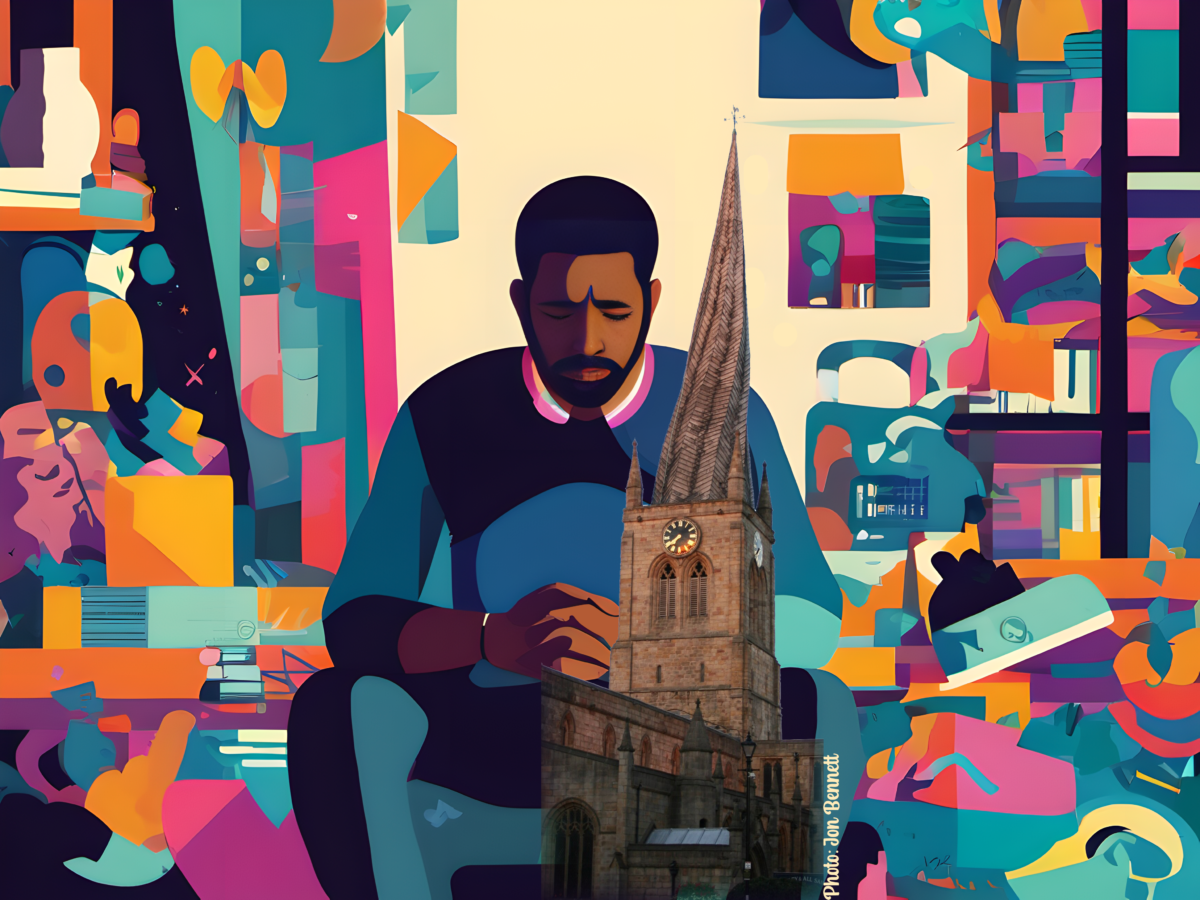
But the Chesterfield spire isn’t okay. It’s twisted round and kind of bending over. I’ll put a photo of it in the image for this podcast episode, because it’s really quite something. And yeah, I’ll put photos of it in the show notes as well at overcomecompulsivehoarding.co.uk.
But people love the Chesterfield crooked spire, because it’s Chesterfield’s crooked spire.
Local people are like, yeah, it’s our crooked spire. Visitors are like, wow, I’ve never seen anything like that before.
And rather than being ashamed of a clear imperfection, it’s embraced and it’s nurtured.
And the other thing about imperfection that felt very relevant to this podcast was that when you can find a community of people who share some kind of imperfection, that can really help to ease some of the shame and difficulties associated with it.
I know that one of the things that Changing Faces does, that charity, is groups for young people who have a visible difference. And they can find that at the start, they felt very, very self-conscious. But then as they met other young people who also had a visible difference, even if it’s a different one to theirs, they realised that not only were they not alone, but also that there were other people fighting the same battle that they were fighting.
And that if you can get six of you or 60 of you or 600 of you together, and you’re all fighting the same battle, then you are stronger and you have empathy for people and you get empathy from other people.
You understand each other and create that kind of supportive environment that comes more naturally when people get together because they share something that they or others judge about them.
And one of the things this podcast has done for me on a really personal level is help me find other people with hoarding disorder.
And something I hear from you is that it’s helped you because you can hear somebody talking about hoarding in a way you’ve never really heard anyone talk about it before.
And if we didn’t share this weird imperfection of having way too much stuff and struggling to get rid of it, we wouldn’t have that sense of recognition or shared understanding, or that sense of there’s somebody who really understands me.
And that’s so valuable.
And when we are hating ourselves, it’s really hard to dehoard. It’s really, really hard.
If you hate yourself and can think of nothing but how disastrous you are, first of all, that most likely makes you miserable.
And when you’re miserable, it’s hard to get anything done.
But also, when you hate yourself and don’t deserve anything good and are a terrible person, and can’t think of anything but those things, why on earth would you ever feel like you deserve nicer surroundings?
It can feel like, yeah, my surroundings look awful, but that just fits what an awful person I am.
And so the more down on ourselves we are, the harder it is to do anything proactively to change our surroundings and change our circumstances.
And so vicious cycles begin in earnest. And it’s really, really, really hard to make any improvements, either personally or to our surroundings.
And so as long as we hate ourselves, everything’s harder. And as soon as we can start to appreciate ourselves a bit, say yeah, that’s weird and quirky, but okay.
Or I don’t like that about myself. Let’s look at why.
Or I have this big secret problem, but it turns out other people have this big secret problem too. And I’m not alone.
If we can turn self-criticism into some kind of self-acceptance, some kind of stopping battling with ourselves and the world, some kind of appreciating that we’re being authentic rather than having that inner conflict of who people think I should be versus who I actually am, things ease.
And it’s almost cliched how much a nearly 300-foot church spire stands proudly and resiliently against the wind and the rain and how much – the cliche being the image of how significant that standing tall and standing strong in the face of being unquestionably warped is for us when we’re thinking of it in mental health terms.
People love the spire because it’s flawed and different. People appreciate it being different and imperfect and warped and twisted.
And maybe if we let ourselves be our authentic selves, people would appreciate our unique, flawed, imperfect selves as well.
It’s been a while since I’ve read out one of your hoarding secrets.
So periodically I ask listeners to send in their hoarding secret because this is such a secret in my own life. And I know that a lot of you keep it secret or you’re open about it to some degree, but you have secrets beyond that.
And so I set up a form ages ago that people can send me their hoarding secrets. And I have no way of identifying who sends it in. It’s just one question, I think, what is your hoarding secret? And all I receive is the text you enter and the date and time it was sent.
And so I’m always really clear that if you send me your hoarding secret, that is to use on the podcast. And so I’m always so proud of people who send one in because it is to be read out.
And that is a big, brave thing, even anonymously. I know all about that.
So it’s been a while since I’ve read one out. So here is a hoarding secret that somebody sent to me:
I promised myself this time after moving into a new apartment, that I would quit hoarding, that I finally would report with my landlord when a problem arises.
Well, I have tried so hard and have made enormous progress. Though, as us hoarders know how truly difficult it is to change our collecting habits, as much as I wanted it to be different this time, it wasn’t.
It all began with a leak under the kitchen sink. I thought, oh no, I will be evicted for certain if I report this with all my belongings stacked and everywhere.
So I figured out where the sink had been leaking. And I used a bucket to contain the leak.
It was was under control, this excited me. All while I knew how terribly wrong this was to not report this leak right away.
All I could think was this will buy me time to quickly undo the hoard.
Now thinking back about my logic, this was absolutely ridiculous, considering for the past 10 years I have been hoarding, not ever stopping, including through two moves.
Well, initially it was only supposed to be a week. I set the deadline for myself and I thought then I will report the leak.
Well, the week turned into two months and the leak kept on getting worse until a scary thing happened. The apartment building had an emergency and they had to come into my unit, so I became quickly brave and reported the leak, since I knew at that moment they had to come in no matter what because of the emergency in the building.
When the maintenance man had arrived, he hammered the sink’s pipe back into place and it was fixed, easy fix. Also, he never even said anything about my clutter.
My insecurity of me being so worried about an eviction, I joked with him and muttered something about how I was decluttering and I apologised for the mess.
He told me he understood and said he didn’t see anything wrong with my apartment.
I realised then the leak could have been easily fixed and it was not as scary as I initially thought it was.
And considering I was being too harsh on my own self and space after all, this maintenance man helped me realise that I am not a complete disaster and there is hope.
The more I work on my hoarding issues and I had, in fact, made bigger improvements and could not even really see it because I am the one hoarding. I love your podcast, thank you.
So first of all, thank you so much for sending this in. I love it because it is so relatable.
I keep having problems with my kitchen sink taps and I keep thinking, oh, I will report it, I’ll just do this first. I will report it, but I just need to… okay, I’ll give myself a deadline and then not do it.
So I fully relate to this whole thing, it’s just a slightly different bit of the sink. I could have written it myself.
Really proud of you for reporting the leak, even if it took that emergency elsewhere to do it.
Really glad that the maintenance guy was able to reassure you. He presumably is in and out of different homes all day, every day and barely notices the surroundings, most likely.
And has probably seen worse and probably seen better.
And I do think that as long as they can get to what they need to get to, they mostly don’t care beyond that.
Having said that, that’s easy to say, isn’t it? And you don’t know if your particular guy who shows up will be judgy or will report you for something or quite what’s going to happen.
And so you did really well. And I’m glad it’s been able to show you that you are making progress, even if you hadn’t been able to see it.
Things are shifting for you. And that’s brilliant. I’m really, really glad.
And if you want to send me your hoarding secret anonymously, you can do so at overcomecompulsivehoarding.co.uk/secret.
Do you have any burning questions you’d love me to answer?
My first Q&A episode was really popular. And so I’m open now to more questions.
Contact me on Twitter, Facebook, TikTok, Reddit, YouTube, or plain old email. All the links are on my website at overcomecompulsivehoarding.co.uk.
Ask me anything and I’ll do my best to answer.
So my top tip this week is, when you read decluttering advice, you might come across advice to be ruthless in terms of what you get rid of, which may fill you with horror.
But if you find that your reaction to that is thinking, I couldn’t be ruthless. I mean, maybe at a push, I could be ruthless with old magazines, but I couldn’t with clothes or books.
Then go for being ruthless with old magazines.
Or if you think, I could maybe be ruthless with visible trash, but I couldn’t with shoes or stationery, then go for it and be ruthless with visible trash.
Listen to the objection that your head comes up with. And if there’s a maybe except in there, pick that out and give it a go.
It’s worth a try.
Okay, thank you for listening. And I will speak to you next time.
Thank you for listening to the Overcome Compulsive Hoarding with That Hoarder podcast.
You can find more online at overcomecompulsivehoarding.co.uk. You can find me on Twitter at That Hoarder and on Facebook at Overcome Compulsive Hoarding with That Hoarder. To find
out more about how you can support the podcast and the overall project, go to overcomecompulsivehoarding.co.uk/support. And do subscribe to the podcast to make sure you don’t miss any future episodes.
There may be links in this podcast that earn me money. This doesn’t come at any extra cost to you if you ever make a purchase through the links, and it helps to support the future of the podcast.
Audio credits
- Intro and outro music: cheesepuff
- Transition whoosh: Vilkas_Sound
- Piano Playing Classical Music: IESP
- Hallelujah chorus: deleted_user_2906614
- Uh oh: stib
- Angels: pycckuu20032003
- Phone: HarryPeeks and Aesterial-Arts
- Yay!: Reitanna
- Fanfare: humanoide9000
- Explosion: Iwiploppenisse
- What? What? What? max_cristos
- Why? Why? Why? Why? Reitanna
- Celebration: Gabriela_Melo
- Not again: xtrgamr
- Atmosphere 17: DaveJf
- Wah wah: SpliceSound
- Giggles: kim.headlee
- Help me: brandonreese
- Please don’t flush: PMBROWNE
- Horror laugh: klankbeeld
- Oohs and aahs: noah0189
- Applause: Sandermotions
- Heartbeat: Tobias Ludwig
- Countdown – female : Tim Kahn
- Game Over – evil: Rocotilos
- Countdown – male: jppi_sstu
- Oh yeah: metrostock99
- Amen: klankbeeld
- Cuban happy music: szegvari
- Suspense: Warped_Tension
- Ding dong: MatthewWong
- Former intro and outro music: grapelemon