
Show notes
Transformation and comfort rarely go hand in hand, especially when it comes to overcoming compulsive hoarding.
In this episode, I talk honestly about why making real change means facing discomfort, based on a quote from Healing Justice London that “transformation and comfort do not live in the same house”.
I challenge us to identify the difference between familiarity and comfort, and share practical ways to push through those tough moments – because growth comes from getting a bit uncomfortable.
If you’re tired of mistaking chaos for comfort, this one’s for you.
- “Transformation and comfort do not live in the same house” (Healing Justice London)
- The universal truth behind the idea
- The necessity of discomfort for real transformation
- Discomfort Versus Comfort in the Hoarding Context
- Familiarity as a source of “comfort” for those who hoard
- Risks of equating familiarity with true comfort
- The need for change and its inherent discomfort
- Examples of positive outcomes after embracing discomfort
- The Reality of Discomfort in Dehoarding
- Emotional and physical challenges of dehoarding
- Potential for overwhelming feelings and anxiety
- Catastrophising and perfectionism surrounding decision-making
- Emotional toll of letting go and possible identity implications
- Acknowledgement that discomfort does not mean failure
- Familiarity Versus Authentic Comfort
- Distinction between feeling comfortable and something being familiar
- The false sense of control and security provided by clutter
- The actual consequences of living in a hoarded home:
- Physical hazards (tripping, blocked access, risk in emergencies)
- Social isolation and shame
- Lack of practical comfort (e.g., not sleeping in one’s own bed)
- The hidden, ongoing “slow burn” of stress and discomfort
- Motivation and Community
- Importance of recognising the true discomfort of living with hoarding
- Community connections via the podcast and accountability Zoom sessions
- Methods to share resources and reduce isolation
- Reframing Discomfort as Growth
- Viewing discomfort as a sign of progress rather than a warning
- The parallel discomforts of both dehoarding and continuing to hoard
- Making conscious choices between competing difficulties
- Strategies for Managing Discomfort
- Taking small, manageable steps to build resilience
- Being gentle and compassionate with oneself during the process
- Reaching out for support (friends, family, therapist, peer groups)
- The use and benefit of accountability sessions
- The Broader Benefits of Transformation
- Improved physical space and wellbeing
- Increased self-confidence and pride
- Better relationships and decreased shame
- Regaining practical functionality and freedom at home
- Enhanced overall quality of life
- Practical Suggestions and Further Resources
- Trying a small, uncomfortable but positive task today
- References to previous episodes for deeper exploration:
- Sitting with discomfort and distress tolerance (Episode 49)
- Building resilience (Episode 70 with Dr. Jan Eppingstall)
Links
- Podcast ep 190: What if we forgive ourselves, but now we know better, we do better? Choosing compassion over shame in hoarding disorder
- Podcast ep 49: Sitting with discomfort: distress tolerance and hoarding – How unconscious distress avoidance might be worsening your problems
- Podcast ep 70: Resilience and hoarding with Dr Jan Eppingstall of Stuffology
- Enough, the Podcast
- Come to a Dehoarding Accountability Zoom session: Accountability Booking Form
- Website: Overcome Compulsive Hoarding
- Become a Dehoarding Darling
- Submit a topic for the podcast to cover
- Questions to ask when dehoarding: https://www.overcomecompulsivehoarding.co.uk/podquestions
- Instagram: @thathoarderpodcast
- Twitter: @ThatHoarder
- Mastodon: @ThatHoarder@mastodon.online
- TikTok: @thathoarderpodcast
- Facebook: Overcome Compulsive Hoarding with That Hoarder
- Pinterest: That Hoarder
- YouTube: Overcome Compulsive Hoarding with That Hoarder
- Reddit: Overcome Compulsive Hoarding with That Hoarder subreddit
- Help out: Support this project
- Sponsor the podcast
Subscribe to the podcast
Transcript
You are listening to That Hoarder: Overcome Compulsive Hoarding.
Learn about hoarding disorder from me, somebody who has it.
I promote a better understanding of hoarding disorder, a stigmatised mental health condition that is mocked rather than treated with compassion.
I want to change that, and by talking openly and honestly about hoarding, I hope to start conversations that help.
Find out how to support the podcast at overcomecompulsivehoarding.co.uk/support. Finally, I am not a doctor, I’m just a hoarder doing her best. So do seek professional support if and when you need it.
This episode is sponsored by Cambridge University Press, publisher of Dr. Lynne Drummond’s new book, Everything You Need to Know About Hoarding.
Struggling with hoarding disorder, feeling ashamed or guilty about your belongings and afraid to let them go is more common than you might think, affecting up to 6% of the general population.
But despite its prevalence, seeking help can be challenging. This new book provides a clear description of hoarding, exploring it as a symptom of other issues as well as a condition in its own right. You’ll learn about different treatment options and find step-by-step guidance and tools for recovery in the self-help section.
Personal narratives and case studies make this guide accessible and relatable for those affected by hoarding, as well as their loved ones and health professionals.
Don’t let hoarding disorder control your life. Take the first step towards recovery today with this invaluable resource. Everything You Need to Know About Hoarding is out now.
Buy your copy at cambridge.org/EverythingHoarding and the E and the H are capital letters.
Get 20% off with discount code HOARDING20.
Hey, how are you? Things here are fine.
A couple of years ago, I was at an event and there was a quote that really stuck with me and I wrote it down and I think it’s true in a lot of areas of life.
And to be clear this event wasn’t anything about hoarding – or mental health even.
But the quote was from an organisation called Healing Justice London and what they said was, “transformation and comfort do not live in the same house”.
“Transformation and comfort do not live in the same house.”
And that stuck with me because, well, firstly because it’s incredibly true and secondly because it really made me face the fact that if we want transformation we need to deal with some discomfort.
And it’s a bit of a challenging idea but it’s actually really important for our journey.
But also, we can be so afraid of discomfort, when actually we’re focusing on the wrong thing.
There are a lot of times in our lives that we’ve felt out of our depth or in a difficult situation and it’s led to incredible things.
Going to a job interview, going on a first date with someone you end up falling madly in love with.
You push through some discomfort or you put yourself into some discomfort and it ended up with brilliance.
In the context of hoarding, comfort is often linked to familiarity, to staying the same, things staying the same, not taking risks even if that is detrimental.
But the thing about transformation, which if we want to live differently we need to pursue, is that – by definition – it requires change.
Change can be inherently uncomfortable. Share on X And change can be inherently uncomfortable.
It might well be the case that for a long, long, long time we found comfort in an accumulation of objects.
That’s where the comfort zone has been. It’s familiar, it might feel secure, whether it actually is or not is a different matter.
It might help us to avoid difficult decisions.
Those things are what make it feel comfortable, what make it feel like our comfort zone.
But transforming our lives so that we have a home that serves us, so that we have a home that’s healthy and not full of risk, so that we have a home we enjoy, does involve stepping outside that comfort zone, stepping outside of familiarity and risking discomfort.
Dehoarding and in a similar way not over acquiring, they’re difficult things, they’re incredibly difficult or we’d have done it.
And that’s not just emotionally difficult, it can be physically quite difficult to dehoard.
Dehoarding is not comfortable, it can be really uncomfortable.
So it can involve physical exertion, it can be tiring, it can be overwhelming. We can find ourselves asking ourselves ‘what if’ about every single decision we make and catastrophising about potentially discarding something we later want, that kind of thing, that can feel very heavy.
There’s an emotional toll, or there can be an emotional toll associated with letting go of things. There can be a lot of anxiety about making decisions.
Things can look sometimes like they’re getting worse before they get better. We can fear judgment, we can go through all kinds of cycles of overwhelm and this is impossible and despair and then back to overwhelm again.
Familiarity and comfort are not actually the same thing. Share on X And if we feel like our identity is tied to our possessions, that can be deeply uncomfortable to then get rid of those possessions.
So there’s a lot of discomfort associated with dehoarding and I’m not ever pretending there isn’t, but that doesn’t mean we shouldn’t do it.
It doesn’t mean we have to live in unwieldy, unsafe, uninviting, unhappy homes to avoid that discomfort.
It’s normal to feel that discomfort – if you hoard these are very common and familiar feelings.
You’re not failing because it feels uncomfortable to do these things. If anything, feeling that discomfort means that you’re pushing yourself. It means that you’re challenging yourself and that’s an important thing.
But I think the first thing I want to talk about in terms of comfort and discomfort and transformation is that familiarity and comfort are not actually the same thing.
It’s easy to think something’s comfortable just because it’s familiar. When it’s familiar, it’s known, it’s predictable. We don’t have to use excess mental energy to make decisions or change things.
We know the score and that’s familiar.
When we hoard, the presence of stuff, even if it’s a chaotic and oppressive presence, it’s familiar.
It’s what we’re used to.
We might have lived like this for a really, really long time and that familiarity, as well as mistaking it for comfort, we can mistake it for control as well.
But actually, familiarity and comfort are not necessarily the same thing.
Comfort is about ease and wellbeing and peace and security and it may well be that a hoarded home does not provide those things.
The reality of living in a hoarded home is often the opposite of comfortable. Share on X The reality of living in a hoarded home is often the opposite of comfortable.
It might involve a lot of bashing your shins on boxes or tripping over clothes or not being able to find something to wear because nothing’s clean because you’re overwhelmed by laundry.
It might involve lots of adrenaline when somebody knocks on the door. It might involve terror if you get a leaky tap.
It might involve excess danger if you fall or if there’s some kind of emergency and you can’t get out.
It might contribute to social isolation if you can’t invite friends over, if you can’t date because you know you can’t have somebody over.
None of those things are the same as comfort.
We’ve kind of convinced ourselves – well, I certainly have – that this is what comfort is, but actually what it is is familiar and it’s avoidant and it’s like the stuff that surrounds me is serving a number of purposes – maladaptively, not helpfully, but it is.
Somewhere along the line my brain figured this was a solution.
I wish it hadn’t but it did.
But it’s not comfort, it’s just familiar.
If we can make progress with our dehoarding, we’re stepping out of our comfort zone in a number of ways.
We’re pushing ourselves to make more progress in ways that is uncomfortable, but it’s important to remember that by dehoarding we’re not giving up the comfort of a full home, because what we might be giving up is the familiarity of a full home.
But it’s worth thinking about whether that idea that that’s the same as comfort is a false one.
We're not incapable of dealing with discomfort. We know discomfort! We already live in an uncomfortable way. Share on X We’re getting a false sense of comfort from the fullness, from having too much, and putting ourselves through and leaving that familiarity can help us to gain genuine comfort, lasting comfort, authentic comfort, rather than something that’s familiar but actually causing a lot of problems in our lives if we make ourselves look at it.
Most of us who hoard know that it can feel very lonely and isolating.
One of the things I get from listeners is that sense of connection and I hear from you that you get the same from the podcast too. If you come along to a dehoarding accountability zoom session, you can find some of that community in real time, or if that’s not possible, by sharing podcast episodes on your social media or with others directly, you can help others to see that they are also not alone, especially those who’ve never told anyone they hoard.
To join a zoom accountability session, go to overcomecompulsivehoarding.co.uk to share an episode on social media, just use the share button in whichever podcast app you listen on.
Thank you.
Not being able to sleep in our own beds is not comfort. Getting mice isn’t comfort.
Not being able to properly clean, causing ourselves physical pain because we can’t move around easily, they’re not comfort.
Shame and embarrassment we might feel, stress about how we live, that’s not comfort.
Not having a sense that our home is a sanctuary away from the stresses of the world, that’s really sad, it’s definitely not comfort.
Not being able to use your freezer or your bath, again, that’s not comfort.
Not being able to find things when we need them, breaking things just because we’ve lost track of where they are.
We might have got used to it, it might be familiar, we might have got accustomed to it, but it takes a toll on our wellbeing. Share on X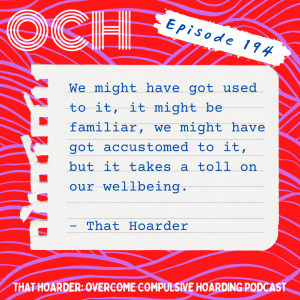 Living without hot water, the strain on relationships, none of those things are comfort.
But there’s also like a slow burn of discomfort as well as those daily acute forms of discomfort.
And the discomfort I’m talking about is the constant underlying knowledge and awareness that this is a problem and it needs to be fixed and I need to be fixing it and it’s tiring.
And we might have got used to it, it might be familiar, we might have got accustomed to it, but it takes a toll on our wellbeing.
And I think a good first step in thinking about this thing – about whether staying as we are is actually as comfortable as we like to think it is – is clocking those things that actually feel uncomfortable when we allow ourselves to acknowledge that.
Because when we start to recognise those sources of discomfort, when we start to recognise just how present that lack of comfort is when you live in a hoard, that is all evidence that we can squirrel away in our heads that will help to remind us when we are forcing ourselves into the definite discomfort of dehoarding, all of that evidence we’ve been gathering about how actually living in a hoard is not a source of comfort, that will help to power us through the difficult bits of dehoarding.
So if we’re rethinking how we look at the idea of comfort and discomfort, and if we’re thinking about transformation and that Healing Justice London are correct that transformation and comfort do not live in the same house, one way to think of that is reframing discomfort as a form of growth rather than it being something that tells us to stop, backtrack, abort mission. We see it as a sign of stretching ourselves, a sign of progression.
Every time we are able to let something go, every time we don’t bring something home, every time we make a decision that moves us forward, it’s a step towards better things and actually it can help to remember that it’s not that dehoarding is discomfort and not dehoarding is comfort.
As I talked about, there’s plenty of discomfort involved in hoarding, there’s plenty of discomfort around living in a hoarded home, so sure, dehoarding can be really uncomfortable, but not dehoarding is also really uncomfortable.
So it’s not like we’re having to choose, do I go with the discomfort of dehoarding or not? What we’re choosing is between the discomfort of dehoarding and the discomfort of not dehoarding, which sounds miserable when I say it out loud, but actually I find that a really helpful way of looking at things.
Can we reframe discomfort as a form of growth, rather than it being something that tells us to stop, backtrack, abort mission? Share on X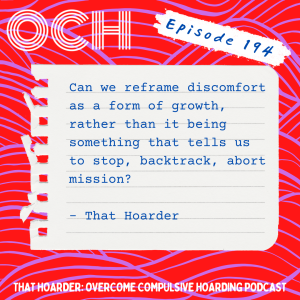 Like it’s not that not dehoarding is the easy solution, it’s just hard in a different way, both options are hard.
So if we accept that, we can say okay it’s going to be hard either way, so I may as well do the thing that will get me towards where I actually want to be.
Managing discomfort, because we don’t want to fling ourselves into hell, we don’t want to go all the way into terror, but we can test the waters, we can take tiny steps and if they still feel too big, make them even tinier, because it all helps us to learn to build resilience and to build momentum as well, and to prove to ourselves that we can tolerate discomfort.
Being gentle with yourself is also pretty useful when you’re trying to deal with the discomfort of dehoarding.
I talked a couple of weeks ago in episode 190 about compassion, compassion for ourselves and compassion for other people.
And that kind of gentleness and compassion is vital if we’re going to explore feeling a different discomfort to usual.
We might be used to the familiar discomfort of living in a hoard. we might not be used to the discomfort of dehoarding. and we might need to kind of hold our own hands through that.
We can also reach out to other people, hold their hands as well, whether you’ve got friends or family or a therapist, or whether you come along to the dehoarding accountability Zoom sessions I run, or you’ve got a peer support group.
The support systems to virtually hold your hand, or to cheer you along, or to remind you of why you’re doing this can be really, really helpful as you face maybe a new kind of discomfort.
Dehoarding can be really uncomfortable, but not dehoarding is also really uncomfortable. Share on X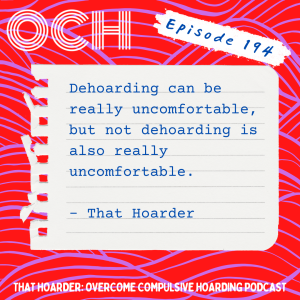 Because the benefit of facing this different kind of discomfort, and actually making positive changes, and actually getting rid of things, the benefit is the transformation not just of our homes, but of our own sense of bravery, our own sense that we can cope with new things, our own confidence in being able to tolerate discomfort and unfamiliarity.
We hope to have an improved home at the end of it, but it’s not just about that. It’s not just about how we feel if someone knocks on the door. It’s not just about not tripping over things.
It’s about feeling a bit proud. It’s about getting home from work and feeling like, oh my lovely house, rather than getting home from work and feeling, oh god this again.
It’s about getting exercises from your physiotherapist that involves stretching out on the floor and being able to do that.
It’s about if, god forbid, there’s a fire or ambulance staff need to come in and stretcher you out, that can happen.
So sure, your home will look nicer, but there’s these massive range of benefits when your stress is reduced.
And when you’ve got a sense that you’ve been able to realise a goal that you might have had for years on some quiet level, that boosts your self-esteem. It gives you a sense of accomplishment, as every positive step does.
We don’t have to get all the way to a magazine-ready home before we can feel proud of ourselves.
We can feel proud every time we make a good decision, every time we make a decision that moves us towards where we want to be, instead of away from where we want to be.
And that is all backed up by maybe a reduction in shame, maybe better relationships with family and friends.
You get more freedom. There’s more possibility in your life. There’s more ability to breathe, to move, just to exist in a nicer way.
And it’s going to take some discomfort to get there, but not feeling that discomfort doesn’t mean you’re living in a utopia.
It means you’re living in a hoard with all of the stresses and annoyances and underlying anxieties and physical barriers that that involves.
Transformation and comfort do not live in the same house. but discomfort that we feel as we dehoard doesn’t mean we shouldn’t do it.
It’s not a sign to stop. It’s not a sign that we’re doing it wrong or that we’re failing.
We don't have to get all the way to a magazine-ready home before we can feel proud of ourselves. Share on X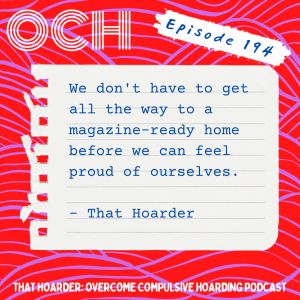 It’s an indication that we’re taking brave steps and making positive changes.
Because we are worth that effort and we are worth that discomfort.
And maybe we can test it out today by making one tiny, if necessary, uncomfortable decision.
Pick one uncomfortable task. Notice the discomfort. See how that feels. Observe it.
And then do the thing anyway.
In episode 49 of this podcast, I talked about sitting with discomfort. I talked about something called distress tolerance. And if this is a topic you’re finding useful, that might be a good episode to listen to as well.
And in episode 70 with Dr. Jan Eppingstall, we talked about resilience. That might be another good resource for you.
I will link to both of those episodes in the show notes.
We are capable. we can build confidence and resilience. And a home that is liveable isn’t an impossibility.
But we have to deal with some discomfort if we’re going to get there.
And we’re not incapable of dealing with discomfort. We know discomfort! We already live in an uncomfortable way.
What we need to be able to deal with is unfamiliarity, unfamiliar discomfort.
And we can, we absolutely can.
It’s the bit where That Hoarder shouts out someone wise.
So shout out this week to a podcast called Enough, the Podcast.
Have a listen to this guest:
When we congratulate ourselves for the small wins along the way as well, because we tend to overlook that, we tend to berate ourselves for things.
We go, oh yes, you’re on this journey of change but you’re still not quite there yet.
Okay that shifts the whole perspective.
But when you actually focus on the small wins, what that does is it reduces dopamine.
Dopamine is a reward-based learning mechanism that told you what you did to get to that point where you felt good. Let’s do it again, and it reinforces that loop.
So every time you take time to find compassion for yourself, you know, congratulate the small wins, have a little gratitude journal, it can all help to continue on this journey of change.
Because otherwise you’ll start to think, oh but I’m still fawning in XYZ.
But what about that time that you didn’t fawn? That’s going to be a reminder to go, okay, actually you are doing the work.
It is helping, it is changing, and that’s I think very powerful.
So I will link to Enough, the podcast in the show notes at overcomecompulsivehoarding.co.uk.
Do check them out for any links and previous episodes that I’ve mentioned.
Okay, thank you for listening and I will speak to you next time.
Thank you for listening to That Hoarder: Overcome Compulsive Hoarding podcast. It’s been a pleasure to have you on board.
You can find all the links I’ve mentioned and a transcript of the episode online at overcomecompulsivehoarding.co.uk.
To find out more about how you can support this podcast and the overall project, go to overcomecompulsivehoarding.co.uk/support and do subscribe to the podcast so you make sure you don’t miss any future episodes.
There may be links in this podcast that earn me money. This doesn’t come at any extra cost to you if you make a purchase through those links and it helps to support the podcast. Thank you for listening to That Hoarder
Audio credits
- Intro and outro music: cheesepuff
- Transition whoosh: Vilkas_Sound
- Piano Playing Classical Music: IESP
- Hallelujah chorus: deleted_user_2906614
- Uh oh: stib
- Angels: pycckuu20032003
- Record scratch: kwahmah_02
- Phone: HarryPeeks and Aesterial-Arts
- Yay!: Reitanna
- Seriously? rydra_wong
- Retro power up MaoDin204
- Fanfare: humanoide9000
- Explosion: Iwiploppenisse
- What? What? What? max_cristos
- Why? Why? Why? Why? Reitanna
- Celebration: Gabriela_Melo
- Not again: xtrgamr
- Atmosphere 17: DaveJf
- Birds: aladar
- Wah wah: SpliceSound
- Giggles: kim.headlee
- Help me: brandonreese
- Please don’t flush: PMBROWNE
- Horror laugh: klankbeeld
- Oohs and aahs: noah0189
- Applause: Sandermotions
- Heartbeat: Tobias Ludwig
- Countdown – female : Tim Kahn
- Game Over – evil: Rocotilos
- Countdown – male: jppi_sstu
- Oh yeah: metrostock99
- Frog: daveincamas
- Amen: klankbeeld
- Cuban happy music: szegvari
- Suspense: Warped_Tension
- Ding dong: MatthewWong
- Ticking clock: ycbcr
- Former intro and outro music: grapelemon