Show notes
- Podcast ep 52: When you need to declutter urgently
- Podcast ep 26: Putting like with like
- Podcast ep 16: Dealing with overwhelm
- Podcast ep 38: Procrastination and hoarding, with Dr Jan Eppingstall
- Podcast ep 34: Stop giving your stuff to people who don’t want it
- Be Well By Kelly podcast
- Podcast ep 30: Create new habits and make them stick
- Podcast ep 46: Tiny habits and micro-movements with Dr Jan Eppingstall
- Website: Overcome Compulsive Hoarding
- Questions to ask when dehoarding: https://www.overcomecompulsivehoarding.co.uk/podquestions
- Twitter: @ThatHoarder
- TikTok: @thathoarderoch https://www.tiktok.com/@thathoarderoch
- Facebook: Overcome Compulsive Hoarding with That Hoarder
- Pinterest: That Hoarder
- YouTube: Overcome Compulsive Hoarding with That Hoarder
- Reddit: Overcome Compulsive Hoarding with That Hoarder subreddit
- Help out: Support this project
- Sponsor the podcast
Subscribe
- Apple Podcasts / iTunes
- Google Podcasts
- Spotify
- RSS
- iHeartRadio
- Amazon Music
- Audible
- Stitcher
- Podchaser
- Pandora
- Deezer
- Podcast Addict
- Player FM
- Podcast Index
- TuneIn and Alexa
- Castro
Audio credits
- Intro and outro music: grapelemon
- Ding dong: MatthewWong
- Transition whoosh: Vilkas_Sound
Transcript
Welcome to the Overcome Compulsive Hoarding with That Hoarder podcast. I am drowning in stuff and trying to find a way out. Listen as I explore the issues and delve deep, as somebody profoundly affected by hoarding disorder. Find out more, including links to subscribe to the podcast and all my social media, at overcomecompulsivehoarding.co.uk. Finally, I am not a doctor, I’m just a hoarder doing her best, so do seek professional support if and when you need it.
So today I am going to talk about DOOM. And I’m going to talk about OHIO. And I’m going to talk about how DOOM and OHIO relate to hoarding, as well as executive dysfunction, and some other stuff.
So I know that sounds like nonsense. And you’re wondering if I’ve had a stroke, and I’m mixing my words up, but I haven’t because DOOM and OHIO are acronyms.
So OHIO stands for Only Handle It Once. Now, OHIO was originally designed as a way to help people deal with their email. The thinking was, if you get an email that requires you to do something, or to reply, and you add it to your to do list, or something like that, and come back to it later, that actually takes as much time as just dealing with it in the first place.
Plus, you get a build-up of work to do you lose the email, you never think of it again, you forget it ever arrived. And it’s really inefficient.
So the thinking of OHIO is you get an email, and you deal with it there and then. And then you open your next email, and you deal with that there and then as well.
However, like with many tactics, especially around productivity, people have expanded the way it can be used. So rather than just looking at OHIO as an email management tactic, people have started to apply it to things like decluttering as well.
So the thinking is that you pick something up and you make an immediate decision on how to handle it so that you can just get it off your plate, you can move on to your next thing.
So you’re not wasting time, you’re not wasting energy, you’re having to come back to something later, when you could have just made a decision the first time you picked it up.
Only Handle It Once.
And it can be a good philosophy to use. However, it is not perfect. And there are times it would be actively disruptive.
So I’m going to talk more about what it is, how it works, but also look at where it might not be helpful and where it could even cause problems.
So the idea behind OHIO: you pick something up, you make a quick decision. It’s really efficient. And you don’t have to have the mental load of remembering you’ve still got to do something because it’s just done. You don’t have to have an ever growing to-do list because it’s just done. You don’t have, in the context of dehoarding, another pile of things to sort through that you’ve already handled because, OHIO, you only handled it once.
So you might have a pile of clothes, you pick up a pair of jeans and you either think these are my favourite jeans, I will put them in the bag ready to go to my bedroom. Or you think they haven’t fitted me in six years. Even if they did, I’m not keen on them. Then that would go straight in the charity shop bag or the bin, depending.
You don’t have to ever think about that pair of jeans again. The decision is made, they’ve been handled once, and it’s done.
And I do this with some things for sure.
Particularly around things like email. So say I get an email and somebody is saying, could you send me that document about that thing? And what I tend to do is, there and then, send them the document about the thing. Because it’s quick, it’s easy, and it saves me having to store in my memory. Don’t forget to send Bob the document about the thing.
It’s efficient, it takes a load off my mind, basically, if I do something straight away.
If I had lunch with a friend, and then later that night, I think, Oh, I promised I’d send them that link to that brilliant Twitter account, then I will do that there and then as I think of it, because it takes as long to do that as it would to make a note somewhere and say, don’t forget to send Louise the link to the Twitter account.
So there are times that it’s a really obvious, automatic thing that is really efficient and saves a lot of time and a lot of mental energy, which is just as important.
However, it is not perfect. And especially given that, you know, the context of this podcast, the reason you’re listening, the reason I’m talking, is about hoarding. This is obviously a lot harder, it’s easy to send a link, when you think of it, it’s easy to attach a document to an email as soon as you receive it. It’s a lot more difficult to deal with a pile of emotional items or valuable items with that much efficiency, it feels almost flippant, sometimes, to just pick something up, make a final decision, and move on to the next thing.
It's a lot more difficult to deal with a pile of emotional items or valuable items with that much efficiency, it feels almost flippant Share on XThe opposite of OHIO, however, is churn, which is one of my least favourite words. You know, some people have that with moist? I’m okay with moist, but I can’t stand churn.
But anyway, churn is where you go through basically the same items again and again and again and again. So you might just move them from box to box or sort one box into two different boxes, and then move those boxes around the house and then periodically sort through them again, but nothing actually leaves the house, they are just periodically sorted and moved.
So the good thing about OHIO is that it really reduces the risk of churn. I hope I’ll never have to say that word again.
So that’s obviously a really quick overview. So I’m going to look in more detail now at the benefits and drawbacks.
So the first benefit is that OHIO, only handling things once, is efficient and streamlined. When you can do it, whether that’s because it’s a suitable situation, or you’re in the right state of mind, it is really efficient, it is really streamlined.
You can just make fast progress and get a lot done.
And it encourages you to just address one item at a time. I know, sometimes, if I have a big pile or a bag full of stuff that I’m trying to sort out, it can be overwhelming, the amount of objects in front of me and I can find myself almost with like one item in my left hand, one in my right hand, and in my head. I’m already looking at the other items in the pile.
The good thing about OHIO is you’re only handling each thing once but as you’re handling it, you pick it up and you look at that item alone and you’re not distracted. You’re not diverted. You’re just dealing with the item that you’re handling once.
And you don’t have to remember to do things later.
I know sometimes if I’ve had a lot of things in my head that I know I need to do. And I don’t think they’re especially weighing heavily on me until I get a big piece of paper and write them all down. And as soon as they’re out of my head and onto paper, I feel so much relief that there’s just freed-up space in my mind. And I think we don’t realise how much we carry around in our heads that is just a long list of things we have to remember or things we have to think about.
So anything that can reduce that load should be welcomed into our lives with open arms.
A good thing about OHIO is that it helps you to learn to make decisions more efficiently.
The one thing OHIO really challenges is that tendency to delay decisions and put decisions off and think I can’t decide on this now, I’ll put it to one side and make a decision later.
OHIO insists that you make the decision there and then, and that is really hard for a lot of hoarders, a lot of us find that very, very difficult, which is part of the cause of the problem we've got Share on XOHIO insists that you make the decision there and then, and that is really hard for a lot of hoarders, a lot of us find that very, very difficult, which is part of the cause of the problem we’ve got. Decision making is so hard that we avoid decision making and any amount of sorting, throwing, donating involves a lot of decisions.
So OHIO can almost train us to get better at making quick decisions.
And it speeds things up, there’s no doubt about that. If you’re only having to go through a pile of stuff once, rather than twice or six times, depending on how many times you delay a decision, obviously, you make quicker progress.
And you instantly shorten your to-do list. If you get through a pile of stuff, or a pile of emails, or whatever it is, then you’ve got less ahead of you that you have to do.
And it can help to combat that overthinking, that procrastination, all of those tendencies that a lot of us really, really struggle with. Again, you’re focused on one item, and you just have to make a decision before you can move on.
And you’re encouraged to be reasonably efficient about that.
I think OHIO is ideal for things like if you have a pile of junk mail, something that is not emotionally loaded for you, is quite practical, and isn’t stuff that’s going to involve agonising decisions.
So I think a pile of junk mail is ideal for OHIO, that’s not stuff you want to put to one side and deal with again later. And then again later, and then again later. It’s something that you want to just pick things up and go through one by one. And then once you’ve gone through them all, they are all in the bin, in the shredder, in the recycling, wherever they’re meant to be.
So OHIO can work really, really well with that kind of thing.
The first drawback of OHIO that I want to talk about is related to that final positive. While OHIO is ideal for things like piles of junk mail, I think, it is really, really not ideal for things that that would be incredibly difficult decisions to make.
Whether that’s because they are items that evoke strong emotions in you, they may be objects that you really feel you treasure and resist getting rid of because they feel so important to you.
If it’s that kind of thing, then having the pressure to make the decision in one go and not do anything else until it’s made could really slow you down, if not stop you in your tracks altogether.
And while OHIO forcing us to make decisions can absolutely be a benefit, it’s where it can also really be a drawback.
Decision-making about clutter is a huge, ongoing difficulty for a lot of us. And if it was as simple as saying, well you just have to pick it up and make a decision, we would probably have already picked it up and made a decision.
This is a tool designed to improve efficiency at work. It’s not a tool designed to help people with quite a severe mental illness tackle their hoard.
And that’s not to say it can’t help, as I said above, I think it’s got some real benefits.
But I think expecting a workplace efficiency tool to be the answer to all hoarding problems is naive and inaccurate. I think if we could make quick, easy decisions, I think we already would be making quick, easy decisions.
Another drawback is that it’s just not always practical to drop everything else to deal with one single item. Like what if you pick something up, and you decide to donate it, but it involves looking for a specialist charity shop that accepts certain types of very specific items, perhaps only some charity shops will accept pianos, for instance, or a certain type of furniture.
Stopping decluttering to seek out the right kind of charity shop would absolutely be a distraction.
Or if you’re using OHIO when you’re going through your mail, and you open your mail, and there’s a bill that needs to be paid. If that involves going onto your phone or going onto your computer to open up online banking, and paying the bill and then you see like a Facebook notification, and your email pings, you will be completely derailed. You’re only human.
And so I think that kind of situation is where trying to deal with something in one go can actually be counterproductive.
Similarly, if you come across an item that belongs in a different room, doing OHIO strictly would mean leaving what you’re doing to take the item to the other room.
So you say, I’m going to keep this bra that belongs in my bedroom. So you go up to your bedroom with the bra and put it down, then go back to where you were. And then you say I’m going to keep this book. It’s a cookbook. So that belongs in the kitchen. So you get up and take it to the kitchen.
And then the next thing you need to go back to the bedroom for. It’s really inefficient.
You might have to go from one room to another six times for six objects, when you could have done it all at once.
It takes you out of the moment. If you’re in the zone with your sorting, it takes you out of the zone and it makes you far more prone to distraction.
And also, sometimes you do come across something that’s really complicated for you in terms of deciding what to do with it. And in those circumstances, I do advocate putting it to one side and coming back to it later. If you’re if you’re in the flow and you’re doing really well with a pile and you’re making really good decisions. And then you come across one thing that could stop your progress because it really takes some thought or you might have to speak to somebody else about it, then often it is more efficient to put that to one side and keep going with what you’re doing and then come back to that when you’ve got the mental space to deal with it. Or put it to one side with a promise that you can put it to one side as long as you talk about it with your therapist for instance, at which point you will make a decision.
If you forced yourself to make it as immediately, in order to stick with OHIO, you’d probably decide to keep it because that’s the least risky of the ‘keep or get rid’ decisions.
So it could be counterproductive in that way as well.
Some things just are more complicated than “do I need this pizza delivery flyer?”.
Life isn’t as simple as replying to an email with the attachment they requested.
And certainly dehoarding is rarely that simple.
So I would say use the principle of OHIO. For instance, once you’ve put something in a bag ready to be donated to the charity shop, don’t go back through the contents of the bag to reassess your previous decisions. That turns into an extra obstacle, there’s a strong risk of you changing your mind and keeping certain things.
Apply OHIO to things like that. Once you’ve made a decision that something is going, you’ve handled it once and that’s that.
But don’t use OHIO if it’s going to become counterproductive, if it’s going to actually interrupt your progress in another way. If you’re in the zone, and something’s too difficult, put it to one side, ignore OHIO, which would say that was wrong.
And especially, I think, like many things I talk about on here, keep OHIO as a tool in your toolbox, knowing that it’s perfect for some situations but useless for others. Just like a hammer is exactly what you need if you’re trying to bash a nail into a piece of wood, but it’s pretty useless if you’re trying to drill a hole in the wall.
OHIO, like every technique, doesn’t suit every situation. If you’ve got a pile of junk mail, it’s pretty perfect. If you’ve got clothes ready to be donated, it’s pretty perfect. If you’re going through a box of the most prized possessions of somebody you adored, who’s just died, it is really, really not the solution for most people.
And also, if your decisions will take several steps to complete, such as moving an item to a different room, researching how to safely dispose of it – I know some electrical items, you need to be really careful – or if you need to talk about it with somebody, then OHIO is not the right solution.
So stick it in your toolbox and keep it as an option. But don’t feel like you have to use it in every situation.
Which leads me to DOOM. DOOM is another acronym, which stands for Didn’t Organise Only Moved.
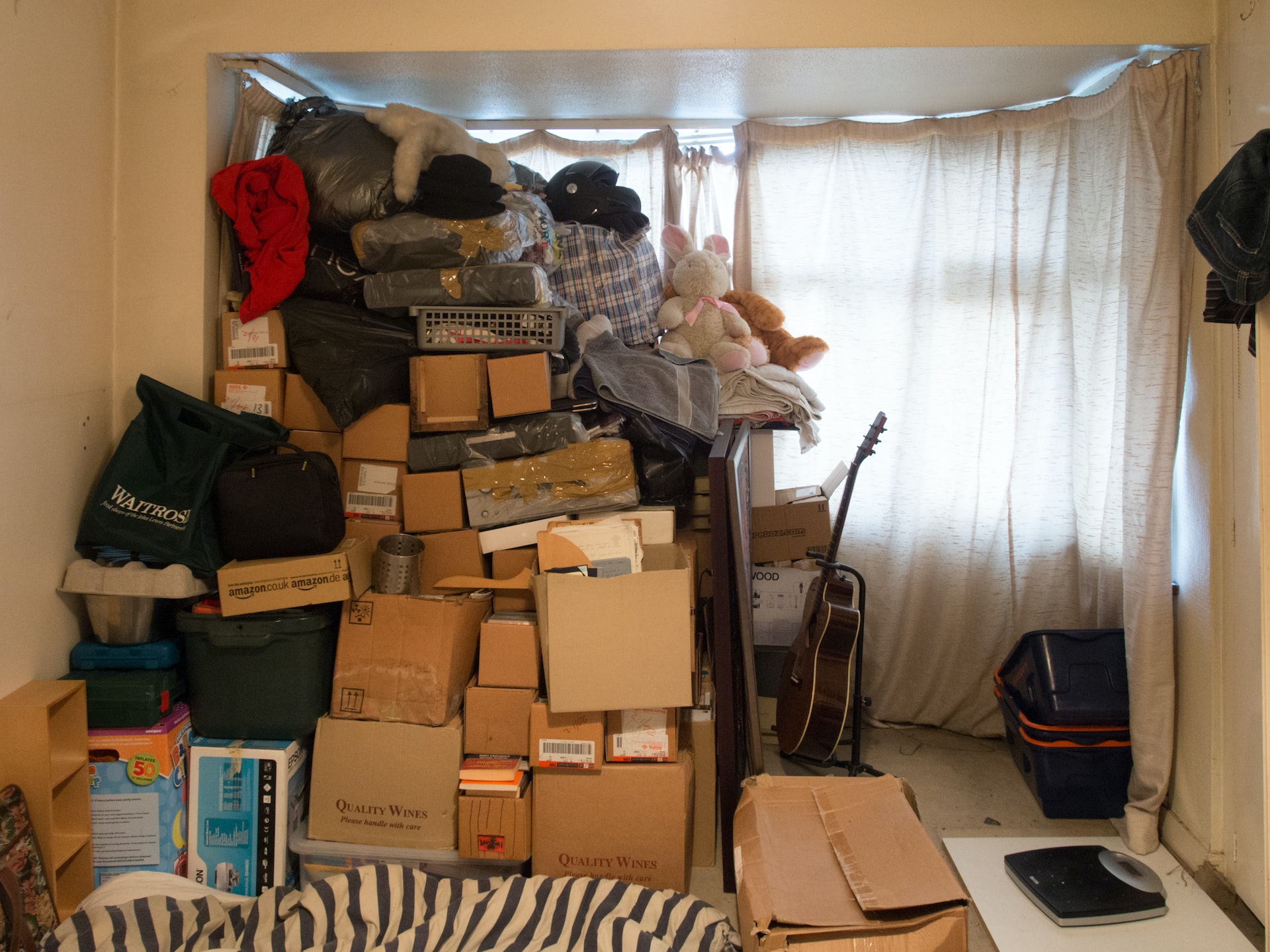
So DOOM is mostly used to mean boxes, DOOM boxes, but it’s sometimes used to mean bags or just piles. And basically DOOM boxes are those boxes that contain bits of randomness, stuff that you didn’t quite know what to do with so you stuck it all in one place. It’s all been stored together, not because it goes together, but because there wasn’t really anywhere else for it to go.
It’s the stuff that builds up, that accumulates and never gets put away because you don’t know where it goes.
DOOM boxes are often those boxes that, when you move to your current house, you brought these boxes, you’ve never unpacked them. But even when you moved to your previous house, you’d brought them from where you lived before that. They’ve just moved with you for decades, but you don’t know what’s in them or you don’t care what’s in them but you can’t quite bring yourself to deal with them.
Now, DOOM boxes have had a bit of a moment on TikTok, where people with ADHD have been saying, if you have DOOM boxes, then you have ADHD. Now this is obviously not the approach to take. And it’s not it’s not a diagnostic criteria of ADHD, you will be unshocked to hear!
However, boxes or bags, or cupboards full of random stuff can certainly be a sign of executive dysfunction, of that kind of inability to just do the stuff that a lot of people seem to be able to do naturally.
Some people see them as a positive, like, they’re a quick way to get bits of clutter out of the way, they’re a quick and easy solution when you have items that don’t have a home. You don’t have to think about them. You don’t have to think about where to put things. You know, it goes in the DOOM box and or it goes in the DOOM bag, or it goes in the DOOM room. Can you have a DOOM house? I may live in a DOOM house. I don’t know if that’s possible.
So even if ADHD TikTokers sometimes say that DOOM boxes are a positive, because they’re a quick and easy way to manage things, that becomes highly questionable, especially when you’re talking about hoarders.
Because we don’t have one discrete DOOM box in the corner of a room. We don’t have a single DOOM box on the edge of our desk. We have a room full of DOOM boxes that move house with us, never get opened, and are full of broken things, forgotten things, things that we haven’t needed for 17 years and yet still feel we need to keep hold of.
If you have one DOOM box that functions like that drawer, you know, the drawer I mean, the second drawer down in the kitchen, the one under the cutlery that has all your takeaway menus and washing machine instructions and a screwdriver and spare staples. That’s okay, that can be workable. It can help you to get things under control if they’re miscellaneous and don’t immediately have an obvious home.
However, that is not how hoarders function. If our problem was one box of random stuff, we’d be fine. You wouldn’t be listening to this podcast if your problem was one box of random stuff. I wouldn’t be making this podcast if my problem was one box of random stuff!
So lots of people, not just hoarders, but lots of people have boxes of stuff that have come with them the last three times they moved house and they haven’t opened them since 1998.
We just probably have more of them than most.
At this level, at the level a hoarder has DOOM boxes, they’re an inefficient way of managing our stuff. They don’t help us to streamline anything. They don’t help us to get organised. And they don’t motivate us to declutter because we probably avoid the DOOM boxes as far as we can.
DOOM boxes are tricky to declutter. Share on XDOOM boxes are tricky to declutter as well. If you’ve got a pile of clothes to sort through, you’re dealing with the same category of items throughout and you can get yourself in the right mindset to deal with clothes. You might have a particular set of questions that you ask yourself that are relevant to clothes. So does this fit? Is this still in fashion? Is this a style I like? Is it in good enough shape for it to be wearable? That kind of thing.
With DOOM boxes, the first thing you pick out might be some coursework for your Religious Studies class when you were 15. But then the next thing might be the back door key from your previous house. Then the next thing like a packet of cross stitch,thread, and then a necklace. And this is harder to sort through because you’re making very different decisions for each item. You go from making a decision about a necklace you’ve been looking for for years, and then making a decision about an empty Snickers packet. And it’s really hard to stay on track and it’s hard to stay focused, because you’re switching from mode to mode, almost.
Now that’s not to say it’s impossible when you think about it, a lot of our home is set up like that when we hoard, it’s just more concentrated in a DOOM box. I know I’ve been working so hard on like with like, but other than the very specific bits I’ve been working on putting like with like, most of the rest of it is a kind of house-sized DOOM box situation.
So if you’re decluttering in a hurry, chucking stuff in boxes to deal with later does make sense. I’m not going to argue against that. If you’ve got a leak upstairs and you need to let a plumber in, throw things in boxes, that’s fine. Nobody would blame you.
I’ve done a whole episode on dehoarding in a hurry, I will link to it in the show notes at https://www.overcomecompulsivehoarding.co.uk/
So in an emergency, sure, throw things in boxes. But if you’re trying to get organised and dehoard in a more long-term way at a more steady pace, throwing things into these boxes, it doesn’t just delay that decision making until later, it also puts those items in a higgledy piggledy state and in a box that you can dread and avoid for the rest of your life, if you let yourself.
So the first thing to say about DOOM boxes – and when I say DOOM boxes, I do also mean bags and cupboards and drawers and all of that stuff – is unless you’re decluttering in an urgent, emergency way, avoid them. The second thing is they might be tricky to deal with, if you’re trying to sort through them and dehoard, but that doesn’t mean they are impossible.
So I have put together some tips for dealing with DOOM boxes when you’re decluttering, when you’re dehoarding.
So number one is if you have already started to create systems in your home, including putting like with like, then dealing with your DOOM boxes will be that bit easier. If you already know exactly where the tin openers live and you already got a bag ready for the charity shop, then you’ll be off to a less challenging start when you open your first DOOM box than you will be if you open your first DOOM box, and don’t have a home for any of the things you decide to keep.
So doing that kind of preparation, even just doing some mental preparation will help a lot.
My second tip is prepare if you need to. There’s something quite intimidating, at least for me, about opening up a box that’s been taped shut for eight years or 38 years. So what would help me is, the day before or the week before I start to tackle a DOOM box, I would want to cut through the parcel tape and open the lid of the box.
Then just leave it like that, not do anything with what’s in it. But just open it up. I feel like that would… it’s a small thing but I feel like that would help me when I then go to deal with it, it would feel a little less scary.
And number three is set yourself up with the usual setup. You know the score by now you need trash bags, you need a bag for donations. You need a plan for the things you’re going to keep, including where they’re going to live. You need a bag or a box for each different room that things can be decanted into.
So when you find something in the DOOM box that belongs in the kitchen, it goes In the kitchen bag, then when you find things in the dream box that belongs in the bathroom, it goes in the bathroom bag, that kind of thing.
Tip number four, don’t remove things from the DOOM box and put them into another DOOM box. That is not the purpose of the bags for different parts of your house. It’s that, have to say it again, it’s that churn thing again. It’s a waste of your time, it gets you nowhere. But it also teaches your brain that decisions are things you put off, that decisions are things you’re not capable of making, that decisions aren’t to be made, they’re just to be delayed.
So don’t fall into the trap of just splitting your DOOM box into two smaller DOOM boxes. You deserve better than the time you would waste on that.
Number five, remind yourself that you have more skills than you think you have. You might be thinking, I don’t know any DOOM box skills. But you know, what you do know? You know skills to deal with overwhelm, and you know skills to deal with procrastination, and you know skills to deal with decision making.
I’ve done episodes of this podcast about them, revisit them if it would help. It sounds like a weird thing to relisten, maybe. But on the interview episodes I do, I obviously do the interview. And then I edit the audio of the interview. And then I go through the audio again for the transcript, because I make sure every episode is transcribed on the website.
So when I do an interview episode, I listen to it at least three times or, well, I participate in it once and then listen to it at least two more times.
And even though I was present in the conversation, there are often things I hear during the editing, or that I hear during the transcribing that I hadn’t really heard the first time the conversation happened, which is quite incredible.
But it’s really valuable to me. I come out of the editing and transcribing process, time consuming though they may both be, with more insights than I had when I’d just participated in the conversation for the first time. So relistening to podcast episodes can do that for you as well.
Tip number six, don’t hate or berate past you for having created the DOOM boxes in the first place.
That won’t get you anywhere. Saying to yourself, I was so stupid, why did I do this? It doesn’t help. It doesn’t help. The fact is they exist and you’re dealing with them now, you’re dealing with them today.
And that’s all you can do. Any amount of hating your younger self won’t get rid of the boxes. And it will probably slow you down because you’re having to deal with a lot of self-hate as well as just the practicalities of a box of random memories.
Tip number seven, use OHIO, as I was talking about earlier, where appropriate.
Obviously, it won’t be appropriate for everything. But for anything that you know you don’t have any long-term use for or any particular love for, use OHIO as a as a method take the opportunity to get rid of some things.
I know I sorted through a DOOM box a while ago, before I knew what they were called. And I found a load of cassettes with the music of my teens on them. And I did play with the idea of keeping them, for nostalgia’s sake. But I also reminded myself that I don’t have a cassette player.
And looking at the playlists, there was nothing on the ones I was looking at that wouldn’t be available on Spotify or YouTube or somewhere, I wasn’t losing music for good.
So what I did with each one of them, I wanted to kind of honour them, honour their importance in my teens. So I would pick each cassette up, I would read through the playlist, I would have a little, little think about the memories that those bands and those songs evoked.
And then I threw them away.
It was unknowingly, OHIO. I was picking each one up, honouring its memory, and then getting rid of it. I wasn’t putting it in another box to sort later, I was only handling them once.
Tip number eight, be realistic about what can be donated. Now I did a whole episode about this, which I will also link to in the show notes, about basically not donating things that aren’t worth anything to the people you donate them to.
And that is always true with hoarding. But I think possibly with DOOM boxes, even more than regular dehoarding. Because I think DOOM boxes might contain… they might be more likely to contain things that have been broken over the years, or that are moth eaten or have been damaged in their time in the box.
Don’t just shift the work of throwing something away onto your local charity shop and make them get rid of something that you should have got rid of.
Do that yourself. If something is really not likely to sell, especially if you remove your emotion from the equation and try and look at an item objectively or impassively and think realistically, would somebody buy this?
If it’s not likely to sell, get rid of it yourself. Don’t kid yourself that somebody else will make use of it. They won’t. And you’re just you’re just adding to the workload of the already quite overwhelmed charity shop volunteers.
Tip number nine, there’s only 11, don’t worry. Block off chunks of time specifically to deal with DOOM boxes until you’ve got through them all. Now, you won’t know until you try what your optimum time period is.
For some people, they work brilliantly for 20 minutes and then just shut down. Other people plough through two hours without too much thought and then need to stop.
And you’re not going to know until you experiment what your optimum productivity is for dehoarding tasks. But start to schedule DOOM boxes, specifically into your dehoarding plans. Because they’re part of the bigger picture and they’re quite easy to ignore, and it’s best not to ignore them.
Tip number 10, keep in mind that the reason a lot of things ended up in the DOOM box was that you couldn’t think of a home for them in the first place. Or you couldn’t find a home for them in the first place. Keep that at the front of your mind and be prepared to think constructively about where things you really, really have to keep are going to live so that you don’t end up with DOOM box version 2.0.
You deserve better than DOOM box version 2.0, I promise you.
And final tip on DOOM boxes. You might want to set some parameters. Maybe only use see-through DOOM containers so that they’re not quite as ‘out of sight out of mind’ as a battered old cardboard box might be.
However, if you don’t have see-through containers don’t use this as an excuse to go out and buy see-through containers, that wouldn’t… no, don’t do that!
Another parameter you might want to set is have a rule that as soon as a DOOM box is full, you tackle its contents there and then rather than ever starting a second DOOM box, or a 12th DOOM box, or a 100th DOOM box.
So have a think about how OHIO and what you’ve learned about DOOM boxes can have an effect on your own dehoarding at home.
It’s all different tools for different tasks. And if you can think creatively and think about… obviously, your individual circumstances are different to mine are different to the next person’s. But think about how you can apply what I’ve said here, and how you can apply any ideas that have come to you as you’ve been listening, whether I’ve mentioned them or not. You might have thought, oh, I don’t think that would work for me, but what if I did this?
Get creative and start applying. I’m so guilty of gathering knowledge and not applying it. And if you’re like that too, try and deliberately make time to think, not just oh, this is interesting, I bet that would help but actually making it help, doing the thing.
Do you have any burning questions you’d love me to answer? I’ll get to the top tip in a second. But my first Q&A episode was really popular so I’m going to be open to questions on a rolling basis and then, when I have enough, I will make another episode answering them.
Contact me on Twitter, Facebook, TikTok, Reddit, YouTube or plain old email – all the links are on my website at https://www.overcomecompulsivehoarding.co.uk/
Ask me anything and I’ll do my best to answer it. Now, your top tip.
So my top tip this week is a little clip from the Be Well by Kelly podcast, where James Clear was a guest and he’s talking about how to form habits and also optimise your habits to make them work as well as possible.
Now, you will recognise the ideas he talks about if you have listened to the podcast episodes with Dr. Jan Eppingstall about tiny habits and micro movements and creating new habits.
And again, I will link to those in the show notes. These are going to be link heavy show notes! But that’s all good because I like directing people to the right place.
So if you’ve listened to those episodes, then let this little clip remind you of some of what we talked about on those. If you haven’t listened to those episodes, then listen to this little clip, and then head over and listen to the episodes with Jan that go into a lot more detail.
So here is James Clear:
I’ve developed what I call the Four Laws of Behaviour Change, and there’s one for each step. So for the cue, the first law is to make it obvious, you want the cues of your good habits to be obvious, available, visible easy to see.
The easier it is for you to get your attention, more likely to stick to the habit.
The second law is to make an attractive. The more attractive or appealing that habit is, the more likely you are to feel motivated to do it.
The third law is to make it easy. The easier, more convenient, frictionless simple habit is, the more likely it is to stick.
And then the fourth law is to make it satisfying. The more satisfying or enjoyable or pleasurable a habit is, the more you have this kind of positive emotional signal that says hey, do this again next time.
So those four stages: cue; craving; response; reward. Make it obvious, make it attractive, make it easy, make it satisfying.
And I just thought that was worth reinforcing because it’s such good information and it’s really evidence based and it’s really a good way to apply. It’s not just a good idea. It’s not an esoteric philosophy. It’s about real life and how to make this stuff stick.
Okay, so thank you for listening, and I will speak to you next time.
Thank you for listening to the Overcome Compulsive Hoarding podcast. You can find more online at overcomecompulsivehoarding.co.uk
You can find me on Twitter @ThatHoarder. And on Facebook at Overcome Compulsive Hoarding with That Hoarder.
To find out more about how you can support this podcast and the overall project, go to overcomecompulsivehoarding.co.uk/support and do subscribe to this podcast, so you make sure you don’t miss any future episodes.
Image: Brett Jordan