Show notes
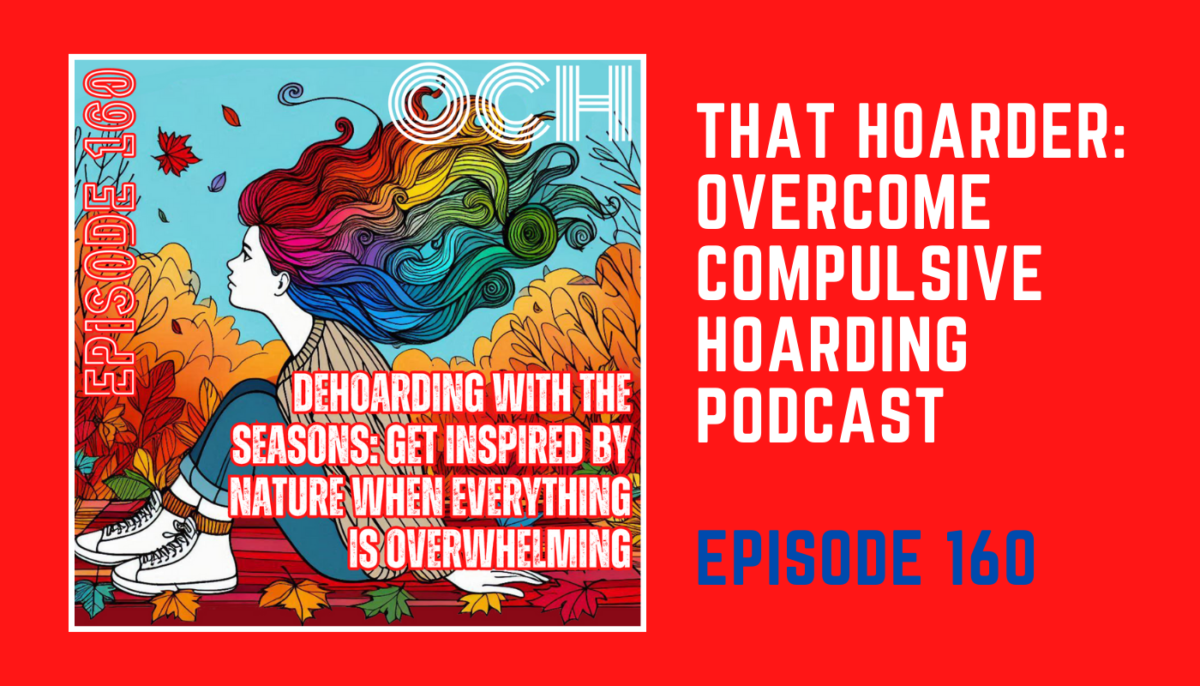
In this episode, I explore how the change of seasons can inspire and motivate dehoarding efforts, with autumn in the northern hemisphere and spring in the southern hemisphere being upon us. Drawing on traditions like harvest festivals and spring cleaning, we’ll discuss how nature’s rhythms can support our journey toward a more organised home. Plus, personal insights on managing the emotional challenges of letting go and tips for embracing seasonal transitions as opportunities for growth.
- Seasonal Influence on Dehoarding
- Autumn Motivation
- Mixed feelings: beauty vs. precursor to winter
- Harvest festivals: gratitude and inspiration for giving and decluttering
- Nesting instincts as a motivational tool for organizing
- Spring Motivation
- Symbolism of renewal and hope
- Growth and change as motivators for overcoming hoarding disorder
- Spring cleaning tradition as an opportunity for new beginnings
- Emotional Aspects of Decluttering
- Acknowledge and understand feelings like overwhelm, anxiety, confusion, and fear
- Use emotions to gain self-insight and understand attachment to items
- Seek support from therapists, friends, family, or professional organisers
- Practical Steps for Dehoarding
- Assess possessions when transitioning between seasons
- Evaluate practical use of items like blankets and coats
- Decluttering inspired by seasonal changes
- Focus on small areas to avoid overwhelm
- Small, consistent changes over dramatic ones
- Set realistic goals for home improvements by New Year
- Community and Support
- Engage in dehoarding accountability sessions for communal support
- Donating items to reduce unnecessary storage
- Assess what you want for your home as the year end approaches
- Aiming for improvement, maintenance, or worsened state?
- Set intentions
- Walking, observing nature, and journaling
- Creating Rituals and Redefining Comfort
- Suggest creating rituals in tune with seasonal changes to aid decluttering
- Redefine comfort by reducing clutter rather than accumulating more
- Highlight the importance of a comfortable, decluttered space for winter
Links
- Northern News podcast
- Come to a Dehoarding Accountability Zoom session: Accountability Booking Form
- Website: Overcome Compulsive Hoarding
- Become a Dehoarding Darling
- Submit a topic for the podcast to cover
- Questions to ask when dehoarding: https://www.overcomecompulsivehoarding.co.uk/podquestions
- Instagram: @thathoarderpodcast
- Twitter: @ThatHoarder
- Mastodon: @ThatHoarder@mastodon.online
- TikTok: @thathoarderoch https://www.tiktok.com/@thathoarderoch
- Facebook: Overcome Compulsive Hoarding with That Hoarder
- Pinterest: That Hoarder
- YouTube: Overcome Compulsive Hoarding with That Hoarder
- Reddit: Overcome Compulsive Hoarding with That Hoarder subreddit
- Help out: Support this project
- Sponsor the podcast
Subscribe to the podcast
Transcript
You are listening to That Hoarder: Overcome Compulsive Hoarding.
I don’t talk in real life about having hoarding disorder, so I talk about it on this podcast instead.
And because I’m anonymous, I can talk really, really honestly.
Subscribe to the podcast and find my social media links, episode transcripts, and every link that I mention at overcomecompulsivehoarding.co.uk.
Finally, I am not a doctor. I’m just a hoarder doing her best. So do seek professional support if and when you need it.
Hey, how are you? Things here are good. I’ve spent some nice time with some nice friends in the last few days, so that feels nice and wholesome.
So, currently, in the Northern Hemisphere, we are going into autumn, and in the Southern Hemisphere, they’re going into spring.
And these are quite significant seasonal changes, and I’ve been thinking about the ways we can use those seasonal changes as a motivation to dehoard.
When I was at school, every year, round about this time of year, there would be a harvest festival where we would all bring in an item of food that would be given then, distributed to people who needed the food.
It was a symbolic way of marking the season, of giving to people who need it, of appreciating if we were in a position to do that, appreciating that.
And harvest festivals, like many church rituals, were originally a pagan festival.
In ancient Britain, the significance of the seasonal changes, and in particular the crops that had just been harvested, hence harvest festival, you couldn’t not appreciate the cycle of the year.
And this tradition of giving thanks for a good harvest now looks a bit different.
Apparently, the tradition was adopted by churches from the 1800s. There was a Reverend Robert Hawker who invited his parishioners to a thanksgiving service at church. They sang hymns of gratitude for “the bounty of the fields and orchards”.
And we benefit from rituals like this, whether you are benefiting because you are receiving food that is being distributed to people who need it, whether you are benefiting because you are lucky enough to be in a position to donate food, or whether you are benefiting just because the harvests were successful and there will be food for another year.
It always felt like a really nice symbol of autumn when it got to harvest festival time at school and at church.
And while I make no secret that I’m not a big fan of autumn, I also know that the reason I’m not a big fan of autumn is because autumn means winter is next.
Autumn itself, if it wasn’t followed by winter, I feel like I’d be able to appreciate the beauty of the changes and the significance of the changes.
I try to consciously do that and to put aside the doom I feel at the incoming winter and say, wow, actually the trees are beautiful, or be mindful and conscious and aware of the changes.
And similarly, for those who are coming into spring right now, that for me is a really hopeful time of year. After months of greyness and cold and wet, you start to see fresh flowers, you start to see blossom on the trees.
So whereas autumn is kind of the death of these things, spring is the start, it’s the renewal of things coming back to life.
And when you are somebody who hoards, we can feel like we are stuck. We are stuck in this lack of cycle.
There’s no cycle. You’re just stuck in your stuff and it’s really hard to deal with and you don’t know how to deal with it.
It can feel like a very stuck place.
So recognising, by these visible changes outdoors, that actually things keep moving, things keep changing, and we can grow and develop and change just like the world around us is doing.
So I’m going to look today at the ways that we can use the seasonal changes that are happening right now as motivation for decluttering, dehoarding, organising, and our thinking around that, in a way that makes the process feel more organic, more cyclical, and hopefully less overwhelming than it may feel currently.
Our moods, our energy levels, our tastes often shift with the seasons.
I suddenly want lentil soup every day. I’ve never had a pumpkin spice latte, but I know they’re a big thing. I just don’t drink coffee. I know that a lot of people are feeling the Halloween spooky season right now.
If you’re going into spring, you might feel the end of this cycle of seasonal affective disorder if you got miserable over winter.
Spring is here and your mood might be starting to improve. You might be feeling more energetic.
Whereas if you’re going into autumn, you might be feeling more like you want to put on a big jumper and read a book and put wholesome food in the slow cooker.
We get this urge to nest and settle in in some seasons. We get the urge for new beginnings and new starts in other seasons.
As things change in the world around us, we can use that as a prompt to make changes in our homes as well Share on X And so as things change in the world around us, we can use that as a prompt to make changes in our homes as well.
Take advantage of the natural inclinations that can come with changing seasons. In terms of our homes here in the UK, it’s the time of year when I’m getting out my blankets again, putting away the fans. If you’re going into spring, you might be putting away the blankets and refinding all your fans.
These changes have an effect on our home as well as our psychology and as well as the outside world.
So whereas the seasons might symbolise growth or preparation or change or renewal, how can we apply those feelings associated with the seasons to our feelings about our stuff, the decisions we make about our stuff and actually what we do in our homes?
While hoarding and having a lot of stuff around us can feel reassuring in many ways, if you feel like nesting especially, if you feel like you need to build that nest around you to feel safe.
But we can get so focused on that that we forget or overlook that this amount of clutter also causes stress.
It causes problems and it causes us ongoing difficulties.
And getting our house in a state that just works better can be a huge relief as well as being quite scary.
So I’m going to start by talking about spring. Partly because I’m jealous of listeners in Australia and New Zealand and the parts of the world that are going into spring right now.
But one of the things that most people associate with spring is spring cleaning.
Spring cleaning is a practice that dates back centuries.
Homes were cleaned after winter to symbolise new life. A lot of people, when the sun comes out in a more consistent way, get energised and go right, new year, new home! I don’t need all this stuff! I’m going to sort it out.
And this kind of ancient tradition has become a modern tradition.
If you’re feeling the need to shed the old and embrace and welcome the new, that can be a perfect sentiment to harness to help you deal with your home.
Even just things like opening the windows, getting some fresh air in can feel renewing, can feel motivating. It feels less stale.
And when you are getting out the fans and dealing with your blankets and your big woolly jumpers and all of that, that’s a perfect time to not just put it away. And when I say put it away, I say that fully in the knowledge that for a lot of us, that doesn’t mean put it in a dedicated cupboard that is designed for it.
It might mean put it in a pile. It might mean put it in a particular corner or in a bag or in a box.
How can we apply those feelings associated with the seasons to our feelings about our stuff, the decisions we make about our stuff and actually what we do in our homes? Share on XSo when I say put those things away, I fully appreciate that that doesn’t necessarily mean you have a designated drawer for winter supplies.
But when you’re putting those things away, whatever that looks like, that’s an ideal time to assess, did I actually use all of these? Do I need all of these?
Maybe we need a blanket in every room. Maybe we need a blanket only in the front room because the bedroom’s quite warm. But if we’re watching TV, it can get a bit chilly in the front room.
Whatever that looks like, when you are putting them in a pile, putting them all together, ask yourself, did I wear all of these woolly jumpers? Did I wear each of my six winter coats? And see whether you can start curating a bit so that next autumn, when you go, right, it’s time to get out the winter coats, the woolly jumpers, the big blankets, you’re only getting out what you realistically will use.
And you’re not storing those unrealistic things for the rest of your life.
And if you’re feeling inspired by new starts because of spring, remind yourself that by getting rid of some of the things that are taking up space when they don’t need to, getting rid of those things, putting them in the bin, giving them to an animal shelter, giving them to a charity shop, you’re making space for new possibilities.
If you’re enjoying the podcast, if you’re learning new things, and if you want to show your support, you can become a Dehoarding Darling.
Dehoarding Darlings get exclusive access to extra insights, recommendations, a Spotify dehoarding playlist, and additional answers from interviewees.
Find out everything you need to know at overcomecompulsivehoarding.co.uk/darling.
If you’re going into spring now, think about how you can harness any positive spring thoughts you’re having and translate those thoughts and feelings into how you deal with your home.
And then for those of us going into autumn, some people also have a tradition of preparing their home for winter by decluttering.
You get to the end of summer and you’re putting away the bucket and spades that you take to the seaside and you’re putting away the swimming costumes and the bikinis and the shorts and t-shirts.
That is an opportunity to assess whether you need to keep them all.
There are some things that you might not need to keep because even though you did use them, you don’t love it and it’s very easy to replace and you might have used it but you actually had several of them and you could only keep one.
Did you wear all of those summer clothes that you’re putting away so diligently? Do they fit? Do you feel good when you’re wearing them? Do you put them on and feel confident? Do you feel like, yeah, this is really me?
Or, actually, are there bits in there that are too tight or that you don’t feel are flattering or that you don’t feel reflect your personality or your style?
Those things, it’s worth asking, can they go?
And if you’re preparing for a winter of lots of indoors stuff, when it goes dark early and you just want to settle in with a mug of hot chocolate and a good film, are these the surroundings you want to do that in?
Is your home setting you up for those cosy autumn winter nights?
Do you feel like your surroundings reflect how you want your mental image of that to be?
Or are your surroundings oppressively full and not that comfortable and don’t represent how you want your life to look?
Think about how you can apply that.
Focus on that slight discomfort feeling and say, okay, how do I translate that into action that will mean that my surroundings improve?
How do I translate that into steps that will make my home a nicer place to cosy up with a film and a big bowl of lentil soup?
Autumn is a time of approaching the end of the life cycle. It’s a time of transition. It’s a time when a lot of people start reflecting.
We’re building up to Christmas and New Year, which is a time when a lot of people start assessing, how do I want my life to be? What changes do I want to make?
And if you’re starting to have those thoughts, embrace that and think about how it can have an effect on your home. You could go shorter term: if you’re worried that when trick-or-treaters knock on your door at Halloween, then when you open the door, they will see your clutter, can you use that to inspire you to clear the space around your front door?
Preparing for winter in this way can lead you to feel more secure and more comfortable.
There is comfort in clutter and there's discomfort in clutter. Share on X There is comfort in clutter and there’s discomfort in clutter.
And thinking about dehoarding can feel very uncomfortable and doing dehoarding can feel very uncomfortable.
But it can also feel freeing and liberating.
That discomfort that we feel as we do it and as we think about doing it can lead to a home that is far more comfortable and safer and easier and less stressful to live in.
So if you’re fantasising about a cosy, organised space for winter, as you’re putting away your summer things, ask whether you need them all.
As you’re getting out your winter things, ask whether you need them all.
If you have just pulled out your winter clothes and any of them are damaged, the moths have got into them or anything is torn or not up to scratch, you don’t have to keep it and use it anyway.
When the world outside is dark and grey and cold, having a home that feels like a home can be so reassuring and comforting, and such an escape from the dark, grey, cold, wet outside.
Take some steps towards making your home the way you want it to be.
If you’re getting urges to fill your home more as a sense of comfort, try and redirect that a bit.
Instead of accumulating more to provide comfort, see whether you can refine more to provide comfort.
Maybe if you haven’t already got out your winter things like blankets and heaters and that kind of thing, before you do that, ask yourself realistically what would a person need? And work that out and then, when you go to get those things out, see whether you can match that up.
“I said to myself I’d need one blanket per room and I’ve just got out 24 blankets and I don’t have 24 rooms, so which of these blankets do I really want to keep? If I need three blankets to get me through winter, which three are my favourites and what can I do with the others?”
Imagine your home as a warm, inviting space that’s just got the stuff in it that needs to be there, that you love, that make you happy.
Imagine your home as a warm, inviting space that's just got the stuff in it that needs to be there, that you love, that make you happy. Share on XThat ultimately can be a far more comforting image than the one we’re living in, which in a misguided way feels comforting or safe, but in reality just isn’t.
And whether you’re going into spring now or you’re going into autumn now, I want us to have a think for a minute as well about… it’s going to be new year in January, it’s going to be 2025.
I asked myself the other day, do you want your home to be in a better state by the time the new year comes in? Even slightly? Do I want it to be as it is, do I want it to be worse or do I want it to be better?
And I thought I want it to be better, so then I thought okay, so if I want my home to be in a better state by the new year, even slightly better, what do I need to do to achieve that?
It’s worth taking a moment to ask yourself that same question.
Do I want my home to be better by new year, even a little, little bit better?
And if the answer is yes, what can I do to achieve that?
If I want my home to be in a better state by the new year, even slightly better, what do I need to do to achieve that? Share on X It might be worth noting down in a notepad, on your phone, in a voice notes app, noting down in what ways you would like your home to be better by the new year and then working backwards from there.
Okay, so I would like my porch to be clear or I would like at least two kitchen surfaces to be clear. So what do I need to do to achieve that?
As you know, if you’ve listened for a while, I have really mixed experiences with goal setting.
If I set a really big goal, it’s too overwhelming and I shut down and can’t do anything. If I set a goal that’s really small, it feels pointless.
So this for me is an experiment with setting quite a vague goal.
By January, will my home be better than it is now? I really hope so.
And to be honest, that very thought has spurred me on this week since I had it.
I’ve taken actions this week that I genuinely might not have otherwise because of that question. Oh, I don’t want to take these bags out. Yeah, but you do want your home to be better by the 1st of January than it currently is.
If we want to see change, we have to do something to make that change happen.
If we want to see change, we have to do something to make that change happen. Share on XChange doesn’t just happen on its own without concerted effort, breaking it down, thinking gradually rather than dramatically. Although, if you’re feeling dramatic and want to do it all, more power to you. Go for it.
But any progress is good progress. Everything doesn’t have to be transformed overnight.
We make things better with those incremental changes and with consistency.
Small, consistent changes are generally more effective than periodic, dramatic changes, if we want the changes to stick and be significant and be consistent.
Let’s see if we can think about the changing seasons as a way to create almost rituals that support our dehoarding, tuning in to the changes that are happening outside, tuning in to how they make us feel.
Do they make us feel like we want to burrow under blankets in cosy but manageable surroundings? Do they make us feel like we’ve got a new start and anything’s possible?
Whether you’re thinking of a refresh of your home for the spring or a harvest-focused giving and appreciating and noting the changes, how can we use that to make noticeable actual changes in our homes?
None of this is easy, right? None of this is easy. It can be difficult emotionally to get rid of things. It can be difficult emotionally to tackle any of it, to sit down and make hard decisions and then act on them.
It is normal for anybody who struggles with hoarding to find that hard. So don’t dismiss those feelings but also don’t let them rule you.
Don’t let that fear make the decisions for you.
Small, consistent changes are generally more effective than periodic, dramatic changes Share on X
See if you can acknowledge the feeling, recognise it, say, wow, I feel really overwhelmed when I think about that.
Okay, that’s valid. That’s real. But what can I do?
How do I work through that overwhelm? How do I manage that and do something anyway?
You might feel really anxious. You might feel panicky. You might feel miserable. You might feel confused. You might feel like you don’t know where to start.
There’s all kinds of feelings and emotions that can come up with this stuff and they can be difficult to manage but they don’t mean we don’t have to deal with the stuff.
They’re not a get-out clause.
They’re something to pay attention to and ask, okay, and what is it trying to tell me?
Why am I so scared? Why do I avoid that particular box?
What can I learn about myself by paying attention to these feelings that feel huge and how can I honour those feelings and then do what I need to do?
And some of that might be support. Some of that might be support from a therapist or from friends or family. It might be coming along to one of the dehoarding accountability sessions I run and doing some dehoarding in the company of other people who are in the same predicament as you. It might be enlisting the help of a professional organiser.
There are ways to get support and help but if we can use the rituals surrounding the changing seasons to give us a purpose, then let’s do that.
If you need extra inspiration, go for a walk. Look at how the trees are changing. Notice what time it goes dark now compared to what time it went dark a month ago.
Do some journaling. How do you feel? How does the new season make you feel? How do you feel about the prospect of changing things in your home?
How do you feel about the idea that you are either going to go into the new year with your home exactly as it is now or with an improved home or with a worse home?
Those are your three options.
Do some journaling about maybe how each of those would feel and which you want to be the case. Set some intentions.
Whether you’re going into autumn and winter or whether you’re going into spring and summer, how do you want that to be?
What role does your home play in that? How can you set up your home to enable that?
Seasonal changes can help us to clarify and focus our minds and if we can tune into them, they can help certain dehoarding rituals feel more natural, less daunting, more like this is part of the natural rhythm of life.
Think about where you can start small. Don’t think about your entire house. Think about one little bit you can improve and then when you’ve improved that, think about the next little bit you can improve.
Our homes are full of an overwhelming amount of stuff but that’s made up of lots and lots and lots of little bits and we can deal with little bits one by one.
I want to hear from you about how the changing seasons are affecting your mood, affecting your thoughts, affecting your motivation and I’d love to hear from you whether you want your home on January the 1st to be in the current state it is, to be in a worse state or to be in a better state and if you want it to be in a better state, what you might do to achieve that.
It’s the bit where That Hoarder shouts out someone wise.
Shout out this week to a podcast called Northern News, which is a comedy podcast and normally my shout outs are for a bit of wisdom that we can all benefit from.
This time it’s a bit… it’s just a funny one because while this is terrible advice, it is also advice that I’m pretty sure we can all relate to.
Have a listen:
Ian Smith: I don’t like taking clothes back. It feels like a defeat.
Amy Gledhill: Would you want me to give you a tip? Buy it online, you get it, you try it on, it either doesn’t fit or doesn’t suit you, put it back in the bag that it came in, then sellotape that bag up, put that in the bottom of your wardrobe, leave it for a year or two and then go what the f*** is this?
Open it back up, go oh my god, try it back on, it looks worse somehow and then you just give it to charity still with the label on and you’ve done a good deed.
IS: Oh yeah, I should have done that.
So I will link to the Northern News podcast in the show notes at overcomecompulsivehoarding.co.uk.
Okay, thank you for listening and I will speak to you next time.
Thank you for listening to That Hoarder: Overcome Compulsive Hoarding podcast. It’s been a pleasure to have you on board.
You can find all the links I’ve mentioned and a transcript of the episode online at overcomecompulsivehoarding.co.uk.
To find out more about how you can support this podcast and the overall project, go to overcomecompulsivehoarding.co.uk/support and do subscribe to the podcast so you make sure you don’t miss any future episodes.
There may be links in this podcast that earn me this doesn’t come at any extra cost to you if you make a purchase through those links and it helps to support the podcast.
Audio credits
- Intro and outro music: cheesepuff
- Transition whoosh: Vilkas_Sound
- Piano Playing Classical Music: IESP
- Hallelujah chorus: deleted_user_2906614
- Uh oh: stib
- Angels: pycckuu20032003
- Phone: HarryPeeks and Aesterial-Arts
- Yay!: Reitanna
- Seriously? rydra_wong
- Retro power up MaoDin204
- Fanfare: humanoide9000
- Explosion: Iwiploppenisse
- What? What? What? max_cristos
- Why? Why? Why? Why? Reitanna
- Celebration: Gabriela_Melo
- Birds: aladar
- Not again: xtrgamr
- Atmosphere 17: DaveJf
- Wah wah: SpliceSound
- Giggles: kim.headlee
- Help me: brandonreese
- Please don’t flush: PMBROWNE
- Horror laugh: klankbeeld
- Oohs and aahs: noah0189
- Applause: Sandermotions
- Heartbeat: Tobias Ludwig
- Countdown – female : Tim Kahn
- Game Over – evil: Rocotilos
- Countdown – male: jppi_sstu
- Oh yeah: metrostock99
- Frog: daveincamas
- Amen: klankbeeld
- Cuban happy music: szegvari
- Suspense: Warped_Tension
- Ding dong: MatthewWong
- Ticking clock: ycbcr
- Former intro and outro music: grapelemon