Show Notes
Website: Overcome Compulsive Hoarding
Twitter: @ThatHoarder
Facebook: Overcome Compulsive Hoarding with That Hoarder
Help out: Support this project
Subscribe with:
Apple Podcasts / iTunes
Google Podcasts
Spotify
RSS
Podcast Addict
Stitcher
Amazon Music
Podchaser
Pandora
Deezer
Player FM
Podcast Index
TuneIn and Alexa
Castro
Audio credits
Intro and outro music: grapelemon
Ding dong: MatthewWong
Transcript
Welcome to the Overcome Compulsive Hoarding with That Hoarder podcast. I am drowning in stuff and trying to find a way out. Listen as I explore the issues and delve deep, as somebody profoundly affected by hoarding disorder. Find out more, including links to subscribe to the podcast, at overcomecompulsivehoarding.co.uk and follow me on Twitter at @ThatHoarder and on Facebook at facebook.com/ThatHoarder.
So I have to start with a big apology. It’s been ages since my last episode, I’m really sorry. I thought I’d take a week or two off. And then, because I was out of the habit, I just didn’t get back to it. But I’m back now.
So thank you for waiting. I appreciate that.
And thank you for the messages I’ve had being generally supportive and lovely about not just the podcast but the whole project, the website, you know, as well, it’s brilliant. It helps, because this is a tough thing to be going through. And it’s a thing that’s difficult to talk about publicly so when I do talk about it, it makes me quite vulnerable and so to receive support is really encouraging. So thank you.
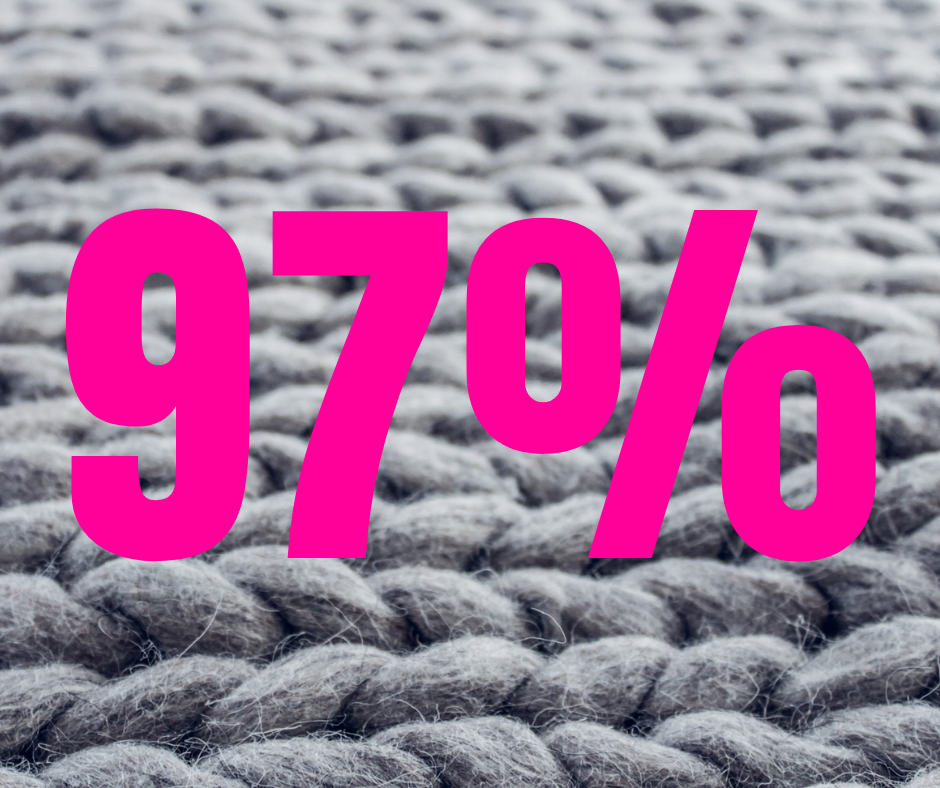
So today, I want to talk about something that I keep seeing when I read things about hoarding disorder. And that is, I keep seeing that it has a 97% recidivism rate. Which is to say that if you get your home tidied up, 97% of people who got their home tidied up will be hoarding again in the future.
So you have 100 people who clean up their space and only three of them retain a clean space.
Now I don’t know about you but I have always found this massively discouraging, like, what’s the point in putting all this effort in to dehoard when the statistics show that it’s not even going to last? However determined I am, however much I try, this is how I’m always going to be. So, why put the effort in now when it will be scuppered later?
What's the point in putting all this effort in to dehoard when the statistics show that it's not even going to last? Share on XAnd so hearing that statistic everywhere has definitely been disheartening for me and put me off making progress at times. So I did a bit of searching, and a bit of research around this statistic. And the most stark thing that I found is that I can’t find any study that actually says this. I can’t find anybody who conducted research into compulsive hoarders to get this statistic. So I don’t know if it’s a number that somebody just pulled out of their head one day and decided it was true or not. But if there is a scientific research article behind it that you know of, then send it to me please. Because I would like to see it. But so far, with a fair bit of searching, I haven’t been able to find it.
The second thing that I did find is that some references to this 97% recidivism rate say that it only applies if there has been a forced clean up. So, if your family comes in and just removes everything you own, without your permission. Now that makes sense, that would screw anybody up, well any hoarder up at least. And it makes no surprise to me that that person would refill their space as soon as they could.
Other references say that the 97% recidivism – it’s really hard to say – others say that the 97% recidivism rate is if somebody cleans up, and dehoards, declutters, when they have no psychological support. So that also changes the outlook a bit because, as I referenced in an earlier episode that you can go and listen to if you haven’t already, I have been having CBT for my hoarding problem. And so I do have psychological support and so maybe that means that the 97% rate doesn’t necessarily apply to me, which is also encouraging because I need all the encouragement I can get throughout this bleeding difficult process.
The other thing I wanted to say about this is that the use of the word recidivism is horrible in this context. The definition of recidivism, according to Oxford, is the tendency of a convicted criminal to reoffend. Now, I am not a convicted criminal and cluttering my home is not offending. It may be offensive but I’m not a convicted criminal who is at risk of reoffending, I am a person with psychological problems who is at risk of relapse.
I think even just changing the word to relapse would be a really good step. Because this is a mental health problem. It’s a very, very complex one, but that’s where it lies. And I know there’s a lot of discussion about what kind of mental health problem and exactly how to define it. But this is clearly not something that mentally healthy people generally do.
So the way I’m trying to look at the 97% relapse rate is that it may or may not be true in the first place. But if it is true, it may apply to me less because so far at least I haven’t had a forced clean up and I have had some psychological support with the dehoarding process I’m going through. So if it’s true but only applies after forced clean-ups, I may be okay. And if it’s true that it only applies if you have no psychological support that I may also be okay.
I need to get that number out of my head and stop using it as a reason to not make progress Share on XI need to stop this statistic – that may or may not be made up – from being a barrier that stops me from making my home livable in. And so that is my goal for the time being, I need to get that number out of my head and stop using it as a reason to not make progress.
In just one second, I’ll give you my top tip of the week. In the meantime, please do subscribe to the podcast, review it (five stars would be amazing!) and share it with your friends or anyone who might be interested, or who might benefit from it. It all really helps.
To find out more ways to support the website, the podcast, and my overall dehoarding project, go to overcomecompulsivehoarding.co.uk/support
Now, back to your top tip.
So today’s top tip is to unsubscribe from every marketing email you get in your inbox.
There are two reasons for this. First of all, there’s less clutter in your inbox. Now I’m not massively concerned about digital clutter myself, but I do know that my inbox is an intimidating place. And so the less crap that’s in there the better.
But the other reason is if you don’t have an email from your favourite shop telling you what is on offer, there’s less temptation to go and buy stuff that you don’t need. So then less comes into the house and you’re dealing with less of a problem.
Now, I wouldn’t recommend going in and trying to unsubscribe from everything in one go. I would recommend one of two things:
- Option one is, every time you get one unsubscribe there and then, so it’s an ongoing process.
- The other is to just every day, find five in your inbox and unsubscribe from them. And then tomorrow find another five, and the day after find another five until they’re all gone, even your favourites, even your favourite shop.
Do it. Thank you for listening and I will speak to you next time.
Thank you for listening to the Overcome Compulsive Hoarding podcast. You can find more online at overcomecompulsivehoarding.co.uk
You can find me on Twitter @ThatHoarder. And on Facebook at Overcome Compulsive Hoarding with That Hoarder.
To find out more about how you can support this podcast and the overall project, go to overcomecompulsivehoarding.co.uk/support and do subscribe to this podcast, so you make sure you don’t miss any future episodes.