Show notes
In today’s episode, I talk about the strategies I’ve been trying to address over-acquisition and manage my finances, from savings pots to practising ‘just-in-time’ shopping. I explain how these methods, alongside mindfully resisting impulse buys and more, are helping me reduce clutter.
- Personal Financial Management
- Dedicated accounts with savings pots for various expenses like glasses, car repairs, and gifts.
- Spending limits.
- Evaluating the necessity of purchases.
- Reflecting on past financial struggles.
- The tendency to overprepare due to fear of scarcity.
- The impact of hoarding on life, such as emotional pain from bereavements.
- The challenge of trusting that resources will be available when needed.
- Shopping Habits and Strategies
- Emphasising rationality in shopping.
- The “just in time” shopping approach to combat over-acquiring.
- Mindful shopping techniques
- Checking existing supplies before shopping.
- Using shopping lists with flexible categories.
- Resisting urge-driven purchases like discounts.
- Mindful Financial Practices
- Exploring alternative uses for money beyond impulse buys.
- Prioritising spending on quality experiences.
- Past Financial Hardship and Emotional Impact
- Past experiences of financial hardship leading to anxiety and hoarding.
- Reflecting on the emotional impact from periods like the COVID-19 pandemic.
- Personal Growth and Overcoming Beliefs
- Encouragement to try despite potential failures.
Links
- Podcast ep 159: Just because we want it doesn’t mean we have to have it
- This Ends in Paris podcast
- Come to a Dehoarding Accountability Zoom session: Accountability Booking Form
- Website: Overcome Compulsive Hoarding
- Become a Dehoarding Darling
- Submit a topic for the podcast to cover
- Questions to ask when dehoarding: https://www.overcomecompulsivehoarding.co.uk/podquestions
- Instagram: @thathoarderpodcast
- Twitter: @ThatHoarder
- Mastodon: @ThatHoarder@mastodon.online
- TikTok: @thathoarderoch https://www.tiktok.com/@thathoarderoch
- Facebook: Overcome Compulsive Hoarding with That Hoarder
- Pinterest: That Hoarder
- YouTube: Overcome Compulsive Hoarding with That Hoarder
- Reddit: Overcome Compulsive Hoarding with That Hoarder subreddit
- Help out: Support this project
- Sponsor the podcast
Subscribe to the podcast
Transcript
You are listening to That Hoarder: Overcome Compulsive Hoarding.
I’m a hoarder who needed an outlet to talk about this unusual and isolating mental illness. And because my hoarding is secret, I started this podcast to talk about it.
Subscribe to the podcast and find my social media links, episode transcripts, and every link that I mention, at https://www.overcomecompulsivehoarding.co.uk/
Finally, I am not a doctor. I’m just a hoarder doing her best. So, do seek professional support if and when you need it.
Hey, how are you? I am doing well.
Let’s start with some housekeeping.
So, tiny, brief, 30-second housekeeping this week.
You can get a calendar to inspire you through 2025. You can join in a dehoarding accountability Zoom session. And you can become a Dehoarding Darling.
You can find all of those links at overcomecompulsivehoarding.co.uk/links.
I didn’t even need 30 seconds. Amazing.
I’m an over-preparer in every area of my life. I’m on Google Maps before I go anywhere to check out the parking situation. I read menus online before I go to a cafe.
I know that not being prepared is, for me, a cause of great anxiety.
And I don’t think it’s a coincidence that the aspects of hoarding, including keeping things just in case and including acquiring more than we need, for me at least, are very linked to this need to always be prepared and never be unprepared.
So, I buy more than I need in the fear of ever being without.
And I’ve talked before on the podcast about a period of my life when I had no money, no income, no ability to replace anything I needed or get anything I needed, and how utterly soul-destroying that was.
If I needed soap and didn’t have any – bad luck, just can’t have soap now. When I needed food and didn’t have any – bad luck, just couldn’t have food now.
It was awful, and no doubt baked into my brain that as soon as I had the means to get the things I needed, I would get them.
And I would get them all, and I would keep them forever.
But even if you haven’t had a period like that, we’ve all used it as a reason to keep something, right? I might need it?
I’ve got to be prepared for the time in my life when having 20,000 magazines, or three broken kitchen tables, or 28 bottles of shampoo will come in handy.
I’ve got to be ready, got to be prepared, I’ve got to be ready for anything.
And as well as making me keep things, this urge, this need to always be prepared and to never be unprepared, does also make me overbuy things.
Tinned tomatoes are reduced, well I’ll definitely use them, so I may as well buy some even though I don’t need them. Nice toiletries, someone will want them as a Christmas gift.
Or like, look I’m okay for toilet paper right now, but at some point I’ll need some more, so I may as well buy some.
Each time, I can feel anxiety rising just at the prospect of being without, of needing something and not having it, of that scarcity panic and deprivation panic creeping in.
Sure, I'm prepared, I've got tinned tomatoes and soap and toilet paper, but I am suffocating in them. Share on X And sure, I’m prepared, I’ve got tinned tomatoes and soap and toilet paper, but I am suffocating in them.
This is no way to live, this is not the ideal, I’m not living the dream because I have enough toilet paper to last for another year. I’m tripping over packets of toilet paper all the time.
This isn’t the dream.
I’m prepared in some ways for imaginary eventualities, but it is overwhelming and impacting my life in a range of ways.
Something I’ve been trying to process most of this year is the two sudden bereavements I had in February and March.
I’ve also been trying… I’ve been working around some past trauma stuff, that is really hard, and the mental work I’ve been doing on those two difficult areas of my life has also really highlighted… like when my friends died earlier this year, being surrounded by stuff, however much of a cocoon I trick myself into thinking it is, did nothing, nothing to help to cocoon me from the awfulness of what was happening.
Being surrounded by stuff did nothing to either prevent my traumas from happening or make it easier to process and come to terms with them.
And if something in me believed that being surrounded by stuff was protective in that sense, it would kind of cushion me from hurt, then it was wrong.
When my friends died this year, being surrounded by stuff - however much of a cocoon I trick myself into thinking it is - did nothing to cocoon me from the awfulness of what was happening. Share on X So I may be physically prepared for a toilet paper shortage, or a baked beans shortage, or a notebook shortage, but it didn’t cushion how distraught I would be when two people I love died in quick succession.
So I’ve been thinking a lot about, first of all, my excessive need to be prepared. Secondly, how that impacts the state of my home. And thirdly, how you can have as much stuff as you want around you, but you don’t know what’s coming.
None of us know what’s coming.
We can think we’re prepared because we’ve got underwear to last us for years, but we don’t know what we’re going to need.
And that’s not a reason to therefore hoard a bit of everything or a lot of everything, because it might be something different.
I don’t think any of us could have predicted a hand sanitiser shortage in March 2020. It happened.
So however much of everything else we have, we don’t know what we’re going to need, and we need to some degree to be able to go with the flow, at least a little bit, and not feel the need to imprison ourselves in our homes in a bid to be prepared for a thing we’re not sure will ever happen, and convince ourselves that if we just have enough of the stuff, we’re safe from hurt, we’re safe from danger, we’re safe from difficulty and insecurity.
So that’s a lot of big thoughts I’ve been having.
And I have a cupboard in my kitchen for tinned foods, and it is literally overflowing. I’ve no idea what’s at the back of it because I can’t get to it, so I only use what’s at the front, or I use what I’ve just bought and ignore the cupboard entirely.
We convince ourselves that if we just have enough of the stuff, we're safe from hurt, we're safe from danger, we're safe from difficulty and insecurity. Share on X I have a bag for gifts, and there are certain things at the bottom of the bag that have been at the bottom of the bag for consecutive years, because at some point I bought them thinking, that will be a good gift for somebody, when in reality I haven’t given it away because it’s a good generic gift, but not ideal for any of the people I’m giving gifts to.
I acquire a lot less than I used to, but I still over-acquire in the guise of being prepared, because it soothes some of the fear and anxiety I have about scarcity and deprivation and insecurity.
But it’s not actually the answer, because the way I live is unmanageable and not serving me.
So I’ve been working on what I’m calling just-in-time shopping.
If I’m planning to have baked beans in the next week, I can buy baked beans, otherwise I don’t.
If I’m planning to make aubergine parmigiana in the next week, I can buy grated cheese and aubergines, otherwise I don’t.
If my favourite jeans are irrevocably torn, I can buy new jeans now, otherwise I can’t.
And I’m mostly doing just-in-time shopping with food, because my cupboards are overflowing, it is not a manageable way to run a kitchen, and it makes cooking and preparing food more difficult than it needs to be.
I am applying it to other things too, though. If I spot a thing that would be perfect for Jenny’s birthday, but her birthday isn’t for months, I’m not getting it. I’m reassuring myself that there will be another thing that’s perfect for Jenny, nearer the time, that I don’t have to store and risk losing in the meantime.
And some of this is about trust, which is really hard for me, but I’m working on it.
Of course, I worry that there won’t be a perfect birthday present for Jenny, or that there will be a baked beans shortage in the future, of course I do. You may remember how much I freaked out when it was impossible to buy tomatoes for about a month, a year or two ago.
But I am learning to reassure myself that there will be something, that I can work it out, that if I’m craving aubergine when there’s no aubergine in the shops, I will be okay, I’ll just have something else.
It’s not the end of the world, it’s just a marginally less perfect birthday present, or a meal that’s not 100% what I’m craving, that’s fine. Worse things happen at sea.
Trusting that we will find what we need is especially hard when you’ve had a period in your life where you couldn’t find what you needed.
Maybe in your childhood, maybe in your adulthood like me, having a time where you need things and really need them and are not able to get them is not only incredibly difficult to live through, but it can scar us in this way that decades later we are still overcompensating and proving to ourselves that it’s okay, we can get what we need.
And in those situations, this trust is incredibly hard.
If you were short of toilet paper at the start of Covid, it might be really hard to limit the amount of toilet paper you buy because you remember that that felt undignified or you didn’t feel clean.
But is our response to that proportionate?
Is filling your home from top to bottom with everything just in case proportionate?
I think what I’m trying to say is that when you have this fear of not having enough or not having what you need, that makes it incredibly hard to be rational about how much you do really need and how much is reasonable to buy or to store or to keep.
And I’m not one of these people who believes that the universe will provide. I find that a very difficult concept to get my head around because there is evidence all over the world today that the universe is not providing for millions of people.
And so that’s not what I’m arguing for. Don’t trust that… I mean, if it helps you, sure, trust that the universe will provide, but that’s not what I’m talking about for me.
I think what I’m talking about is trusting that we can work it out if the universe doesn’t provide.
Trusting that we’ll be okay whether the universe provides or not.
Trusting that if we really fancy beans on toast and we’ve got the bread but we’ve not got the beans, we’ll be okay. We’ll just have something else.
Because part of what shopping does is take us a bit into the future and go, oh, I’m going to wear this then. I’m going to eat this then.
It’s a kind of future-looking thing in many ways.
But our homes are so cluttered with these ideas we had at some point that we never followed through on, or with things that are genuine – maybe we love all of the clothes we’ve bought, but we just can’t sleep in our own bed because they’re all on it.
We need to also think of the present. We need to think of money, cost. We need to think of practicality in terms of, can we store things? Do we have somewhere realistically to put them?
And so if we can start thinking very much in the now: yeah, that craft project looks amazing, but we have a queue of 35 craft projects we haven’t done yet.
This would be a real future purpose. I’m only doing just-in-time shopping. I will leave that craft project on the shelf in the shop.
When I have completed all 35 craft projects in the queue, then just-in-time, I can buy a new craft project that fits with my aesthetic now, that may not be the same as the aesthetic I had three and a half years ago, 35 craft projects ago.
So I’m not talking just about impulse buys, although that is part of it. Impulse buys is a part of it, but I’m also talking about that bit of our brain that buys things for the future and not for now and shifting that to just-in-time shopping.
So now I’m going to talk about how I’m doing it. How am I making that shift?
I enjoy making this podcast and it helps me on a personal level. It’s a lot of work, but the feedback I get makes it worthwhile.
I fund everything about the podcast myself. So if you want to help to ensure the future of the podcast, you can help me to cover the costs by sending a one-off or recurring donation at overcomecompulsivehoarding.co.uk/donate
So the first thing is, as I said, I’m mostly doing this around food, although not exclusively.
But one thing, it sounds simple, but I wasn’t doing it. Before I go shopping, I look at what I’ve already got.
I’m the kind of person who I tend to know what’s in the fridge because I’m in and out of that, but not so much what’s in the cupboards.
So if I don’t know whether I’ve got any tinned soup, I would therefore normally buy some tinned soup that looked especially nice or some tinned soup that was reduced.
But if before I go to the supermarket, I’ve looked in that cupboard and seen eight tins of different types of soup, I know not to get it.
I’m also using lists when I go to the supermarket.
Although I’m very much a list person in life, I’m not especially a shopping list person. My resistance has always been, but I don’t know what’s going to be on special offer. And I try and buy as much on special offer as I can.
So I would have a list and then that wouldn’t match what was reduced in the shop.
So what’s working for me for just-in-time shopping and lists is having kind of categories on the list.
So what I will do is write something like veg that can go with pasta and pesto on the list.
So when I’m in the supermarket, if baby corn is reduced and mange tout is reduced and they’re perfect with pasta and pesto, I will buy those.
But then the next week, if sugar snap peas and courgettes are reduced and baby corn and mange tout are full price, I will get those because all I’ve got on my list is veg that goes with pasta and pesto rather than those specific vegetables.
So lists, but for me, not specific items on the list, more like the gist of what I need.
I’m trying to shop more mindfully as well, avoiding that frantic, exciting feeling of, oh, look at all these discounts and being really conscious and deliberate and so saying to myself, yeah, that is really reduced. However, I don’t need it and if I leave it in the shop, someone else can take advantage of this bargain who actually needs this thing. I know I’ve got six bottles of shampoo waiting to be used. I don’t need this one. Even if it is a great discount, I can leave it behind.
Reminding myself I can say no, again, sounds basic, but is quite powerful.
I can say no, even if it’s a bargain. I can say no, even if I ran out of this thing once in the past. I can say no, even if I really like it.
Those two things can be true. This is really reduced and I like it. I can still also leave it on the shelf.
I did an episode a few weeks ago about just because I want something doesn’t mean I have to keep it and this is a bit like that.
Just because I want the thing doesn’t mean I have to buy it.
Those two things can be true. I can want it. It can be reduced. I can have run out of it in the past and I can still not buy it.
I’m also, if I’m a bit unsure about whether I should buy something or not, thinking of what else I could do with that money is quite helpful for putting in perspective Yeah, I kind of want the thing, but for the price of this, I could also go to that cheap cafe with one of my friends and get a sandwich and chips and have a really nice hour with my friend.
What would I rather use this money for? I’d rather get a cheap sandwich and chips with Jenny than have this thing.
And before I get to the till, I’m also re-looking through my basket or my trolley just to check everything still feels necessary and to check everything is something I’m going to use imminently.
And check that there were no impulse buys in there because even in the space of walking through a few aisles, while I might initially have picked something up and justified it to myself, even a few aisles later, I can look at that thing and think, yeah, no, I was justifying that to myself, but really, I don’t need it and I certainly don’t need it in the next week or two.
And the final thing that’s helping a lot in terms of just-in-time shopping is about a year ago, I did a massive overview of my spending and my budget because I was really broke and I reorganised my entire finances at that point.
And one of the things I did was I started using different bank accounts for different things.
So I have separate bank accounts for separate things.
So I’ve got an account specifically for bills, for instance. So I calculated how much my bills cost every month and at the beginning of the month, I make sure that account has that amount in.
I have an account for spending, just daily spending. So supermarket, shopping, anything like that, going out for a meal.
I have an account for expenses related to this podcast, for instance. I know I’ve calculated how much the hosting and the various things cost and that’s in an account dedicated to this.
And I have an account for saving for various things. This account has savings pots. So even though it’s one account, I can move money into named pots.
So I’ve got a savings pot in there for my glasses. I know that I need about £250 every time I need new glasses, which is about every two years. So every month I try and put about £10 into that savings pot.
I have a pot in there for car repairs. I have a pot in there for gifts.
So all of that means that my money is now separated. So whereas before I had one account that functioned for a lot of those things, it meant that bills might go out and I would have a lot less left than I thought I would, or I would spend some money and not have enough for something else.
For me, having it separated out is brilliant because my spending account specifically has a set amount of money in it every month.
And that’s what I can spend and that’s parameters. It’s a structure.
If there’s not enough in there, then I can’t get the thing.
And I’m not having to worry about have I overspent and therefore can’t pay the gas bill, or I can think I’m going out for a meal with a friend, but actually then the rent goes out of the bank.
And so for me, separating that out means that my spending amount is clear, visible. I can open the app at any time and it tells me how much is left in there.
I can look at that balance and think, okay, I’ve got a meal out next week. I need a certain amount left for that. I’m going to need another food shop before the end of the month.
So with all of that in mind, do I need a new pillow? Can I justify a new pillow? Do I not have enough pillows? Do I definitely need a new pillow this week?
So just-in-time spending for me is balancing out all of these things and trying to combat that urge to over-prepare by,
- reassuring myself that whatever the world throws at me, and however easy or difficult things end up being, I’ll work it out.
- using these new rules, no, these new methods to help to limit my spending and focus my mind when I’m spending, importantly, like lists, like reminding myself I can say no even if…
- focusing on do I need it right now or am I buying this for an imaginary future situation?
- reassuring myself that that period when I had no income and no money was terrible, but that’s not where I am now, and if I get to that point again I will be better served by having not overspent right now.
- the knowledge deep in my bones that there are incredibly painful things that this world throws at us and being surrounded by clutter doesn’t actually fix any of them. Doesn’t protect us from how hard it is when people die, doesn’t protect us from the trauma that we’re either going through or trying to deal with afterwards.
We might think we’re protecting ourselves, but what we’re doing, a lot of the time, is just adding to our own problems by believing that acquiring and keeping all of the stuff is the answer, and I think all of us know on some level that it’s not.
We might think we're protecting ourselves, but what we're doing, a lot of the time, is just adding to our own problems by believing that acquiring and keeping all of the stuff is the answer Share on X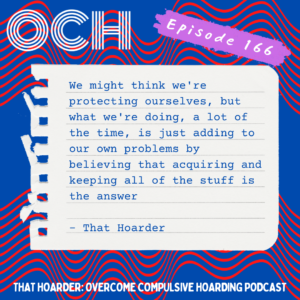 The world doesn’t work like that, life doesn’t work like that.
So have a think, when you’re next shopping, do I actually need this now or is this a future imaginary thing that I can not buy with some level of trust that I’ll be okay without it?
It’s the bit where That Hoarder shouts out someone wise.
So shout out this week to a podcast called This Ends in Paris by Kevin James Thornton, which I will link to in the show notes.
This is a message a caller called in with. I don’t know her name, but I do like the message.
Have a listen:
If I could go back one year right now, I think I would tell myself, you can do a lot more than you think you can.
You have some biases against yourself that make you think that your capability is a lot lower than it actually is.
But you just have to try. And it’s okay if you fail, you can try and it will make you learn something that’s a stepping stone to trying again and again and again until eventually you don’t fail.
So if you are interested in a 2025 decluttering inspiration calendar, if you want to join in on a dehoarding accountability Zoom call, if you want to become a dehoarding darling and get a little extra update from me every month, you can find all of those links at overcomecompulsivehoarding.co.uk/links.
Okay, thank you for listening. And I will speak to you next time.
Thank you for listening to That Hoarder: Overcome Compulsive Hoarding podcast. It’s been a pleasure to have you on board.
You can find all the links I’ve mentioned and a transcript of the episode online at overcomecompulsivehoarding.co.uk.
To find out more about how you can support this podcast and the overall project, go to overcomecompulsivehoarding.co.uk/support and do subscribe to the podcast so you make sure you don’t miss any future episodes.
There may be links in this podcast that earn me money. This doesn’t come at any extra cost to you if you make a purchase through those links, and it helps to support the podcast.
Audio credits
- Intro and outro music: cheesepuff
- Transition whoosh: Vilkas_Sound
- Piano Playing Classical Music: IESP
- Hallelujah chorus: deleted_user_2906614
- Uh oh: stib
- Angels: pycckuu20032003
- Phone: HarryPeeks and Aesterial-Arts
- Yay!: Reitanna
- Seriously? rydra_wong
- Retro power up MaoDin204
- Fanfare: humanoide9000
- Explosion: Iwiploppenisse
- What? What? What? max_cristos
- Why? Why? Why? Why? Reitanna
- Celebration: Gabriela_Melo
- Not again: xtrgamr
- Atmosphere 17: DaveJf
- Birds: aladar
- Wah wah: SpliceSound
- Giggles: kim.headlee
- Help me: brandonreese
- Please don’t flush: PMBROWNE
- Horror laugh: klankbeeld
- Oohs and aahs: noah0189
- Applause: Sandermotions
- Heartbeat: Tobias Ludwig
- Countdown – female : Tim Kahn
- Game Over – evil: Rocotilos
- Countdown – male: jppi_sstu
- Oh yeah: metrostock99
- Frog: daveincamas
- Amen: klankbeeld
- Cuban happy music: szegvari
- Suspense: Warped_Tension
- Ding dong: MatthewWong
- Ticking clock: ycbcr
- Former intro and outro music: grapelemon