Show notes
In today’s episode, I’m sharing nine strategies that are making a real difference in managing my hoarding behaviour and curbing over-acquiring right now. From tricks to overcome perfectionism and opening a daunting pile of letters to finding support in unexpected places and even leveraging a cute app, these tactics are moving me forward. Join me as I lay out what’s working, in the hope it sparks a few ideas for you too.
- Opening 100 unopened letters
- Overcoming fear and procrastination
- Sorting coins and dealing with obsolete items
- Decision-making process in letting go
- Recognising dehoarding as self-kindness, not punishment
- Benefits of having a friend who knows the hoarding situation
- Managing perfectionism and doing things imperfectly
- Using the “hummingbird method” for tasks
- Introduction and use of the Finch app for self-care
- Using virtual assistants for task reminders
- Success with excessive mug collection and food cupboards
- Impact of the documentary “Buy Now” on purchasing habits
- Changing relationship with the inner critic
- Overcoming Mail Anxiety Milestone
- Kindness, Not Chore
- Embrace Imperfection for Future Growth
- Hands-Free Task Management
- Best-before dates at the start of the year
- Consumerism Documentary
- Curbing Instant Gratification
Links
- Podcast ep 124: How the little-known Hummingbird Method can help you to dehoard the areas you’ve been avoiding
- Finch app
- Podcast ep 165: Distraction-free idea capture: Transforming chaotic thought streams into actionable to-do lists
- Buy Now documentary
- Podcast ep 171: Hi Ren: How a song dramatically changed my approach to my inner critic
- Podcast ep 161: Addressing shame with creativity: dancing with your inner critic with artist Steve Chapman
- Podcast ep 82: Dehoarding when you’re drowning with KC Davis of Struggle Care
- Woman’s Hour podcast
- Come to a Dehoarding Accountability Zoom session: Accountability Booking Form
- Website: Overcome Compulsive Hoarding
- Become a Dehoarding Darling
- Submit a topic for the podcast to cover
- Questions to ask when dehoarding: https://www.overcomecompulsivehoarding.co.uk/podquestions
- Instagram: @thathoarderpodcast
- Twitter: @ThatHoarder
- Mastodon: @ThatHoarder@mastodon.online
- TikTok: @thathoarderpodcast
- Facebook: Overcome Compulsive Hoarding with That Hoarder
- Pinterest: That Hoarder
- YouTube: Overcome Compulsive Hoarding with That Hoarder
- Reddit: Overcome Compulsive Hoarding with That Hoarder subreddit
- Help out: Support this project
- Sponsor the podcast
Subscribe to the podcast
Transcript
You are listening to That Hoarder, Overcome Compulsive Hoarding, combating stigma since 2021.
I wanted there to be a podcast about hoarding disorder from somebody who hoarded, rather than a professional.
That didn’t exist, so I created it. And that’s this podcast that you’re listening to now.
Subscribe to the podcast and find my social media links, episode transcripts, and every link that I mention at overcomecompulsivehoarding.co.uk.
Finally, I am not a doctor, I’m just a hoarder doing her best, so do seek professional support if and when you need it.
Hey, how are you? I am okay. A bit anxious this morning, I’m not sure why, but otherwise I am fine.
Today I’m talking about some of the things that are really working for me at the moment, and it’s really nice to have some things that are working, and I thought I would share them with you. So that’s what I’m talking about today.
I am also going to do a success of the week and a weird dilemma of the week, and I have a shout out to a podcast that has a really interesting and useful bit of information about the difference between confidence and self-esteem.
So let’s get going. Let’s start with some housekeeping.
So, brief housekeeping today.
I have a discount at the moment, a discount code you can use for any dehoarding accountability Zoom sessions that you book in January. You can get 20% off the already bargain price.
To get the code for the discount, sign up for my email newsletter, which goes out every Monday. It’s absolutely free, and you can do that at overcomecompulsivehoarding.co.uk/newsletter, and that code will work until the end of January.
Also, if you are an Instagram user and you’re not already following me on Instagram, give me a follow @thathoarderpodcast. Same on Threads, same on TikTok actually, but it would be lovely to see you there.
It’s time for the success of the week and the weird dilemma of the week.
So my success of the week is that I opened about a hundred unopened letters.
As you may remember me talking about before, opening the mail is something I get really stuck on.
I get overwhelmed by it. I’m scared it might be bad news, or I’m scared it might be something scary, so I put it in a pile promising myself that I will open them soon, and then I don’t.
And so what I’ve had is a big bag by the front door that things go into – optimistically – and then never get dealt with, and I sat down with that bag and just opened and opened and opened and opened.
Very few of them were useful or important, but I’m really pleased I’ve managed to do that.
My weird dilemma of the week: I was sorting out some coins. I’ve got various coins that I’ve been just putting into a glass. You know when you find some coins at the bottom of your bag or something like that? And this glass was getting full, so I have been sorting out the coins into the different – what’s the word? Denominations? I know that works for religion. I feel like it works for coins, but if not then that’s embarrassing.
But I’ve been sorting it out into pound coins and two pound coins and 50p coins and all of that. And in among there was a trolley coin… I don’t know whether they are universal, so sometimes at supermarkets when you get your trolley you have to put a pound coin in to release the trolley and then you get your pound coin back when you return the trolley. I guess it’s to make people return them.
And often charities will sell things in the size of a pound coin that you can just attach to your keyring and they work in supermarket trolleys. And it’s a nice little thing that charities can sell in the knowledge that everybody on earth has arrived at a supermarket and realised they don’t have any pound coins in their purse.
But a year or two ago we got new pound coins. All the old pound coins went out of circulation and only new pound coins can be used now. And they’re a slightly different shape, so old pound coins don’t work in supermarket trolleys.
And the charity trolley coin I had was built for old pound coins, not new pound coins.
So it doesn’t work any more.
But I still had a real dilemma about getting rid of it. Some voice about… but maybe it would be… maybe there’s like a circumstance I can’t think of when it would be useful to have this.
And I don’t know what that circumstance could be, but it took me a little while to go, okay this is ridiculous, get rid of the out-of-date trolley coin. And I did.
So there is my success of the week and my weird dilemma of the week.
So I want to talk about nine things that are really working for me at the moment in terms of managing my home, managing the stuff in it, getting rid of things, in terms of not bringing more in, and in terms of my behaviours, my thoughts and feelings, my attitudes to stuff.
I’m aware that obviously a lot of this podcast is about what’s hard. A lot of this podcast is about what’s difficult.
So I thought there could be real value in reinforcing that hard and difficult and complicated as this is, there are things that can and do help.
And a lot of that is discovering for ourselves what works, or discovering for ourselves what works at this particular moment, with the acknowledgement that it may not work for us in 12 months’ time, but still embracing the fact that it does work now and riding that while it is working.
And even if I talk about something today that is helping me, and that isn’t something that would help you, it might spark ideas of things that could help you.
I would also love to hear from you what’s helping you. So do drop me a line. You can always email me at info@overcomecompulsivehoarding.co.uk or you can contact me on any of the social media channels. I like to hear success stories as well as what’s hard and what’s relatable from what I talk about and all those things.
Success stories doesn’t have to be ‘I fixed it all’. It can be ‘I found a way to do this one task that has been hard for years and now I can do it’.
I'm reinforcing to myself that trying to resolve this problem is not a punishment or a chore. It's an act of kindness to myself Share on X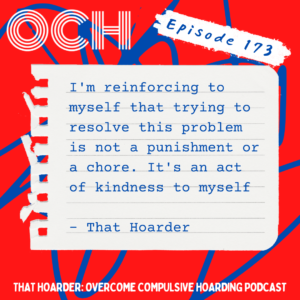 So the first thing that’s been helping me to tackle my hoarding behaviours is reinforcing for myself that trying to fix this problem, trying to resolve this problem is not a punishment or a chore. It’s an act of kindness to myself.
I’m not trying to fix this problem because somebody is nagging me to fix this problem. I’m trying to fix this problem because my life will be better if I do.
My life will be better if I can overcome this or manage this or improve the state of my home to whatever degree.
Shifting the focus of the reason we’re doing it so that instead of oh no I’ve got to do this, it can be oh it would be amazing if I could achieve that because whatever… because I can then invite friends over because I can then invite my girlfriend over whatever that looks like.
And that’s not to say I never go oh no I’ve got to do this thing. I’m not pretending that this whole process is blissful and there are butterflies and birds singing and all of that.
It’s still really hard, but that shift in I’m doing this because I want things to be better, rather than I’m doing this because everything’s terrible, has been a really powerful one for me and it’s helping.
It’s helping. Not just with my progress but with the way I talk to myself, with the way I feel about myself and all of that is relevant and important.
The second thing that’s really helping me is finally having a friend who knows my situation.
Last year having finally told my therapist about the hoarding and that was terrifying and then she was incredibly great about it, but still I was like but she will be the only person who ever ever ever knows.
I'm not trying to fix this problem because somebody is nagging me to fix this problem. I'm trying to fix this problem because my life will be better if I do Share on X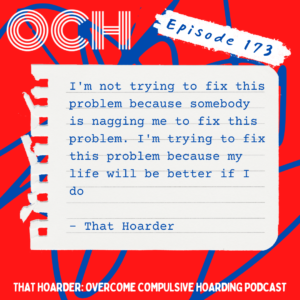 But then over time I started to realise that my therapist knowing was a good thing. It was a good for me to have somebody in real life who knew, and I started just teasing with the idea of telling somebody else.
And it took me a long time to get my head around it and I chose a person who I know to be very thoughtful and caring and I told them.
They reacted beautifully and supportively and they are very much taking my lead, they’re not going right, let me come round and help you sort it out there’s none of that.
It’s great to have somebody who knows and first of all still loves me despite not despite this but them knowing this has not made them back off from me or stop loving me or stop being my friend.
I feel less like I’m lying to everybody – lying by omission of course but still – and it means that if I have a day where I take out 25 bags of rubbish, I now have somebody I can text and go oh my god I took out 25 bags of rubbish today. And because they know the score, they can be as celebratory as I need them to be. Whereas if I said that to somebody who didn’t know, it would be like wow that’s a lot well done, but the gravity of how hard that would have been is not really appreciated.
So having a friend who knows and has been incredible about it is really helping me on a psychological level to feel like maybe a tiny bit less disgusting, and to have a cheerleader when I need it.
The third thing that’s really helping me is this idea I’ve talked about before of when perfectionism tries to take over and I think I can’t do this because it’s not the exact best way to do it, it’s not the optimal way to do it, it’s not the most ethical way to do it, it’s not the most ecological way to do it…
You know, sometimes I throw away old batteries because I know that in reality, putting them somewhere to take to the battery recycling place means I’ll put them somewhere and not see them again for three years and they’ll never go anywhere and I can’t deal with it.
So what’s helping me to come to terms with the fact that sometimes I will throw a battery in the bin – don’t tell me off, I know that’s not ideal. I also know I’m not the person in the world to do it – is that I’m doing things imperfectly now so that I can create the conditions for a life and a home where I can do things more ethically, more carefully, more perfectly, more ecologically in the future.
So rather than either a) getting in my own way by trying to do everything so perfectly that I can’t do anything at all or b) doing things imperfectly and hating myself and berating myself and yelling at myself for doing things imperfectly, I’m choosing c) which is doing things imperfectly and saying to myself, I know this isn’t ideal but I’m doing it perfectly now so that I can create a home and a life that will make it easier to do things in a better way.
If some paper ends up in the main rubbish, if an empty Pepsi Max can doesn’t go in the recycling, if I could donate something but I throw it away instead, I might not feel brilliant about those decisions but I’m beating myself up a lot less because I know that living in this degree of chaos makes it virtually impossible to deal with everything perfectly, and that trying to deal with everything perfectly is a real impediment to making progress.
If we get caught up on every tiny thing, which I know we do anyway, but if we additionally get caught up on I have to dispose of this in the perfect way, it has to not just go to a charity shop but go to the correct charity shop, it has to not just… then we slow down and we get in our own way and we stop making progress and we start going backwards sometimes.
And that’s not helping anybody.
We are not single-handedly responsible for saving the earth.
I'm doing this imperfectly now so that I can create the conditions to do things in a better way in the future Share on X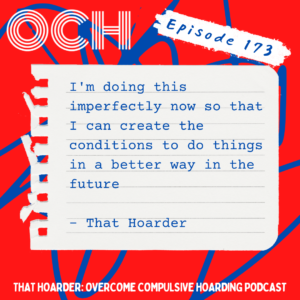 And we can want to do our best but if doing our best is getting in the way, it can really help to say to ourselves I’m doing this imperfectly now so that I can create the conditions to do things in a better way in the future.
Like any independent podcaster, I rely to some degree on my listeners. If you are able to donate to help to ensure the future of this pretty unique project you can do so at overcomecompulsivehoarding.co.uk/donate
If you are not able to, I appreciate you listening and enjoying regardless. Thank you.
The fourth thing that’s really helping me is something I talked about in episode 124 called the Hummingbird Method, where the idea is if you’ve got a task that you need to do but you’re putting it off for whatever reason, you need to kind of hover around the area the task is. Just hover there sit down or make yourself useful over there.
And, sometimes, magic happens and because you’re already there and you’re faced with the thing you’re meant to be doing, then even though your stated intention was not to do it, sometimes you do it.
The hummingbird method is how I sorted out those 100+ unopened letters.
I had the big bag with them all in. I sat down next to the big bag. I had a podcast playing but there was nothing else really to distract me in that area. And I sat down next to the bag, and that was deliberate. I wanted to sort the letters out but I knew I was having trouble making myself.
So sitting down next to them was deliberate but my stated intention was just, I’m going to sit down next to this bag.
And relatively quickly I thought, well I can open the top letter on the pile and see what that is. And I did. And I had made sure I had rubbish bags next to me and a bag for the letters I would need to keep, that kind of thing.
And then once I’d opened one letter, because I was hovering around the area, just sitting on the floor by this bag, may as well open the next letter, may as well open the next letter while I’m here, and one by one, by one, by one, by placing myself in the vicinity of the big bag of letters, I got through them.
The Hummingbird Method is one of those that I don’t want to overuse it in my own life. I feel like it helps to save it for the tasks I’m really, really, really putting off. And it’s not guaranteed, but none of these are guaranteed, but often, often it works for me, and that’s one of many examples of me having to play tricks on myself constantly, play tricks on my own mind to get me to do things.
But when the tricks work, it’s hard to argue.
The fifth thing that’s really helping me at the moment is an app on my phone that a listener recommended.
Now, this app is called Finch, and it’s a free app — there is a paid version, but I don’t have that, you can access everything I need on the free version.
And Finch is an app where you set yourself self-care tasks, and every time you complete one of your own self-care tasks, it provides care for this ridiculously cute little bird in the app.
So you basically adopt this little bird, and every time you tick off that you’ve drunk some water, or you tick off that you have taken some rubbish out, the bird gets a little treat, or the bird gets to go on an adventure.
And at first, I feared that it was going to be like… I’m old enough to have had a tamagotchi — some of you are old enough to have had a tamagotchi — and if you didn’t keep on top of the weirdly precise care routine that a tamagotchi took, it would become really deformed, and it would die.
And so when I first heard about this app, it sounded good, but I feared it was tamagotchi-esque, and if I didn’t do enough self-care, this bird would die, but that doesn’t seem to be the way it works.
Instead, it just gets little boosts itself when you take care of yourself.
And so it suggests some self-care routines that I’ve kept, like drink some water, get out of bed is one of them. I like it when getting out of bed gets me points, but you can also add your own, so I’ve set some around taking rubbish out. I’ve set some around taking a certain number of bags of rubbish out every week, that kind of thing.
And I cannot emphasise enough how cute this little bird is, especially as you complete your tasks, and it gets clothes and little pets of its own.
I hate that this kind of thing works so effectively for me, but gamifying things does seem to help me, and gamifying things when it involves a super cute little bird — I like making the bird happy, I like making the cute pixels on my phone happy, and sometimes I’m like, oh, it’s too cold to take rubbish out today, or I, oh, I’m just tired — I think, oh, my little bird would be really happy if I took this rubbish out today, and once I’ve taken rubbish out five times, the little bird gets a reward, and all of this, it can sometimes nudge me to do it.
So the app is called Finch, it is available on Android and Apple devices, and if you want a little virtual pet that you take care of by taking care of yourself, check it out, and thank you to the person who originally suggested it to me because it’s gorgeous.
The sixth thing that’s helping me at the moment is something I talked about in episode 165, which was about how to capture ideas on your to-do list without getting distracted, because I was having real trouble with wanting to add things to my to-do list, but the minute I picked up my phone or opened my laptop, I would be distracted by a thousand other things.
And I talked about how I’ve been using the virtual assistant in my phone to add things to my to-do list and to remind me to do things.
Because I have an Android phone, that’s Google Assistant. For other people, if you’ve got an Apple phone, that might be Siri; if you’ve got Alexa devices, that might be Alexa.
But basically, what I’m doing is, if I’m in a flow of something, whether that’s that I’m working or whether that’s that I’m doing the washing up or I’m in the middle of some dehoarding that I don’t want to get distracted from, what I will do instead of trying to write something down, or instead of trying to open my phone to add something to my to-do list, I am using Google Assistant to add things to my to-do list.
And so all I have to say is, hey Google, at 12 p.m. remind me to take out some rubbish bags, and it pops up at 12 p.m. with a reminder.
And it’s that simple. I have heard from you that there are different ways to do that on other types of devices, and there’s something about the fact that at 12 p.m. my phone will ping and tell me to do that, and it’s a nudge.
It can’t force me; I can still ignore it, but it’s a nudge in the right direction, and meantime, I have been able to get on with what I was doing without getting distracted, and it’s really, really helpful.
I’m using it for work tasks, I’m using it for life tasks, where over Christmas, when I was visiting various friends and stuff, I was adding tasks that way to my list — things like, at 11 a.m. remind me not to forget to put that person’s present in my bag.
It’s versatile, but it’s helping me get on top of the many tasks I know I forget and I fear I might forget, and so I add it to my list via Google Assistant, and it’s genuinely helping me a lot.
And I know from chatting to some of you at the dehoarding accountability zoom sessions that you’ve started doing similar since hearing about it on episode 165, and everybody’s finding it a revelation, to be honest.
The seventh thing that is really helping is the fact that last year, I more or less got on top of my excessive mug collection.
It took a few rounds. I had a round of I have now sorted out my mugs and got rid of all the ones I possibly can, and then another round a few weeks or a few months later, going, okay, I had not got rid of enough, and I got rid of some more, and then I think it took a third round to go, right, I really, really have to get on top of this.
And I feel like now I am on top of my mug situation, and it is an absolute joy that when I’m unloading the dishwasher, I’m not having to do a jigsaw puzzle to fit the clean mugs into the mug cupboard.
And then at the end of last year, beginning of this year, over the Christmas / New Year break, I sorted my food cupboards out. I sorted out my cupboard of tins and cans, I sorted out my cupboard of pasta and rice and sauces, I sorted out my snacks.
A lovely thing about sorting through your food cupboards at the beginning of a year is that when you're checking best-before dates and use-by dates, it's really easy to spot the ones that are out of date Share on X May I recommend doing that at the end of the year, by the way, or the beginning of the year? I still consider this to be the beginning of the year, so don’t use this as an excuse to delay it now till December. but a lovely thing about sorting through your food cupboards at the end of a year or the beginning of a year is that when you’re checking best before dates and use by dates, it’s really easy to spot the ones that are out of date, because if it says anything other than 2025, it’s out of date, and it can go. Because we deserve food that’s in date.
So I sorted through those cupboards, I got rid of out of date stuff. I never feel great about that. It feels incredibly wasteful, and I feel full of regret that I have got myself into the situation where I have several bags of out-of-date food that just have to go straight in the bin.
But what I do to deal with that sense of regret and that kind of icky… I don’t like this about myself, I don’t like that I have allowed this to happen and that this food that has been picked and prepared and packaged and transported and stored is now just going in the bin uneaten — is rather than use that as a stick to beat myself with, I use it as a reminder that this is what happens when you have too much stuff.
It’s not that you’re terrible; it’s a consequence of having something like hoarding disorder, and what I do is try and harness that feeling to remind myself when I’m wanting to overbuy or when I’m not paying attention to whether I’m overbuying or not.
It's not that you're terrible; it's a consequence of having something like hoarding disorder Share on X I use that feeling, the memory of that feeling, as a reminder that if I don’t want that same problem again, I have to do things differently.
But what’s happened since sorting out my mugs and since sorting out my food cupboards is, first of all, I have a lot clearer idea of what I’ve got.
Secondly I can find the things I want when I want them, and both of those things feel great. They feel great to go, I fancy pasta and pesto, and I know I’ve got pesto, and I know where it is. I fancy something nice to go with a jacket potato; now let me think what I’ve got in the cupboard, and I know what’s there because I’ve been interacting with it and engaging with it, and it’s not overwhelmingly full.
I’m using the knowledge that that feels great. I’m using the knowledge that it feels great to be able to unload the dishwasher and put the mugs in the mug cupboard without some kind of Jenga situation occurring. I’m using the knowledge that those things feel great to help power me on in the rest of my home, and it’s really helpful how one bit of success can then fuel more success, because something’s working, you’ve proved something’s working, and it gives you a little bit of hope that maybe you can make the next thing you work on work as well.
The eighth thing that’s really helping me is I watched a documentary on Netflix called Buy Now, and it is a very good film, and it’s about precisely how the big companies like Amazon, Shein, and so on, precisely how they make customers need their stuff.
It talks to insiders from those companies, who talk about the tactics used, and it talks to environmental specialists who talk about the consequences of all of this overconsumption and fast fashion.
One bit of success can fuel more success, because you've proved something's working, and it gives you a little bit of hope that maybe you can make the next thing work as well Share on X And it’s a very good film. and even though there wasn’t much information in there that I hadn’t known — not much of it was new to me — it was very well put together, and there was something very powerful about it, the way it was put together and it all being in one place.
And I had previously had an Amazon Prime subscription for the ease, basically, so that if I needed something quickly, I could get it quickly.
But literally, mid-documentary, mid-Buy Now, I logged into my Amazon account and cancelled the Prime membership.
I could not deny any more that I did not want to participate in Amazon-land as much as I could.
Now, I’m under no illusion; I will buy things from Amazon again. What I wanted to do, though, was to make it that little bit harder for myself. I wanted to have to interrupt that routine that I’d got into that makes me go, I want that thing, I need that thing, I could get it tomorrow.
I wanted to interrupt that urgency and the ease with which I can get it tomorrow.
I’ve always said Amazon makes it too easy, and the documentary really reinforced that.
And so now I’ve put a barrier in place, where I am avoiding Amazon purchases.
And what I’m finding interestingly is that when I remove the immediate gratification of an Amazon purchase, if I go and look for the same item somewhere else and it will take a week to arrive, or if I look on a different website and it will three days, or if I have to go to a shop to buy it, and that immediacy is removed, the power of wanting or needing the thing is immediately diluted.
It’s fascinating that as soon as the message changes to I could have that thing but in a week, it’s suddenly considerably less appealing.
And so putting barriers in my own way to shop at Amazon and encouraging myself to shop elsewhere, what that’s meaning in reality is I’m shopping less, because the prospect of getting the thing but in five days is so much less appealing that it’s making me realise that the impulsivity and the immediacy was perhaps more important to me with a lot of purchases than the thing itself.
The impulsivity and the immediacy was perhaps more important with a lot of purchases than the thing itself. Share on X And it means, therefore, that the things I do still buy are more likely to be the things I do actually want rather than something I want just because I can get it now.
So watching Buy Now, cancelling my Prime membership, and trying in general to avoid Amazon as much as I can is having more of an effect on my spending than I anticipated.
And the ninth thing that’s really helping me at the moment is this shifting I’ve been doing in terms of my relationship with my inner critic.
In short, I got obsessed with a song last year; it made me realise things about my relationship with my inner critic and how counterproductive the constant battling was, and that song is called Hi Ren.
I talked about it in depth in episode 171, and being obsessed with that song made me look into alternative ways to deal with my inner critic, which meant I interviewed an artist called Steve Chapman in episode 161 about how he started drawing and dancing with his inner critic.
And so for context for this bit, you might want to listen to episode 171 and 161, but basically what I realised was that the constant battling I have always done with my inner critic was not just painful and soul-destroying, it was also making things considerably worse.
And I was not winning.
The song made me realise that no amount of coming up with arguments to defend myself against my inner critic was going to ever make me triumph and say, okay, I have now won.
And that realisation left me with a big hole: if fighting with my inner critic isn’t the answer and just taking constant abuse isn’t the answer, what is?
And I got to the point of realising that, however misguided and ineffective, one of the roles of my inner critic seems to be to try and protect me. Now, I cannot emphasise enough how much this is not the way to protect me. However, when I see her that way, I soften a bit.
Another of her roles seems to be repeating really toxic things she’s learned along the way. And when I see her that way, I feel a bit sorry for her that she’s embodied and absorbed all of that.
And since actively, proactively trying to engage differently with my inner critic, to try and listen and coexist rather than get defensive or get defeated, it’s changing the whole way I deal with myself.
Because I already knew rationally, and reinforced by my conversation with KC Davis in episode 82, that beating myself up was not the way, was not going to lead to a tidy home. Battering myself from the inside was not the solution to hoarding, but I didn’t know how else to engage with that internal battering.
Beating myself up was not going to lead to a tidy home. Battering myself from the inside was not the solution to hoarding Share on X But now I’m trying to do that differently, it’s having an effect on the way I feel about myself, and when I feel less hostile towards myself, I am more inclined to try and build a better life for myself.
And part of that involves dehoarding and sorting and getting rid and not bringing new things in.
So those are the nine things I think are really helping me the most at the moment, and I would love to hear what’s helping you right now.
It’s the bit where That Hoarder shouts out someone wise.
So shout out to the BBC Radio 4 Woman’s Hour podcast. Here, a comedian called Amy Gledhill is talking about what she realised about how just because she was confident, that didn’t mean she had high self-esteem.
Have a listen:
Amy Gledhill:
There’s a difference between confidence and self-esteem, and it wasn’t something that I was aware of.
So I’ve always assumed I must have pretty good self-esteem. I’m confident enough to talk on stage, and then I was reading a few books and kind of digging into that kind of thing for research for the show, and I realised that self-esteem is very, very different actually to confidence.
And it’s one of the things that has become the most relatable in the show is people coming up going, oh I feel the same. I’m confident enough to, you know, hold court or go to a board meeting or do my job really well, but then I accept treatment and behaviour that I shouldn’t, you know, sometimes in relationships, sometimes from family members, whatever it would be.
And yeah, and it was a real journey of discovery, and looking back, it kind of put all my past relationships into context, like oh that’s why I stayed so long.
But I didn’t realise I had low self-esteem. I really genuinely thought I was skipping along through life full of confidence, but it’s it’s different.
And people need to check in with themselves and see how they’re doing in terms of self-esteem because if it is low, it is a bit of a cycle, you know? I talk about it a bit in the show, how if you’ve got low self-esteem, you accept things that you shouldn’t, and then that gives you lower self-esteem, and it just goes on and on and on, and before you realise it, you’re kind of at rock bottom, and you you’re not respecting yourself.
But you might still be very confident and chirpy and bubbly and outgoing, but yeah, self-esteem is different.
That Hoarder:
It certainly made me think more about that relationship between confidence and self-esteem and how one doesn’t necessarily mean the other.
Let’s vow to avoid people who treat us in the kind of way that leads us to believe that’s how we deserve to be treated.
Okay, thank you for listening, and I will speak to you next time.
Thank you for listening to That Hoarder: Overcome Compulsive Hoarding podcast. It’s been a pleasure to have you on board.
You can find all the links I’ve mentioned and a transcript of the episode online at overcomecompulsivehoarding.co.uk.
To find out more about how you can support this podcast and the overall project, go to overcomecompulsivehoarding.co.uk/support, and do subscribe to the podcast so you make sure you don’t miss any future episodes.
There may be links in this podcast that earn me money. This doesn’t come at any extra cost to you if you make a purchase through those links, and it helps to support the podcast.
Audio credits
- Intro and outro music: cheesepuff
- Transition whoosh: Vilkas_Sound
- Piano Playing Classical Music: IESP
- Hallelujah chorus: deleted_user_2906614
- Uh oh: stib
- Angels: pycckuu20032003
- Record scratch: kwahmah_02
- Phone: HarryPeeks and Aesterial-Arts
- Yay!: Reitanna
- Seriously? rydra_wong
- Retro power up MaoDin204
- Fanfare: humanoide9000
- Explosion: Iwiploppenisse
- What? What? What? max_cristos
- Why? Why? Why? Why? Reitanna
- Celebration: Gabriela_Melo
- Not again: xtrgamr
- Atmosphere 17: DaveJf
- Birds: aladar
- Wah wah: SpliceSound
- Giggles: kim.headlee
- Help me: brandonreese
- Please don’t flush: PMBROWNE
- Horror laugh: klankbeeld
- Oohs and aahs: noah0189
- Applause: Sandermotions
- Heartbeat: Tobias Ludwig
- Countdown – female : Tim Kahn
- Game Over – evil: Rocotilos
- Countdown – male: jppi_sstu
- Oh yeah: metrostock99
- Frog: daveincamas
- Amen: klankbeeld
- Cuban happy music: szegvari
- Suspense: Warped_Tension
- Ding dong: MatthewWong
- Ticking clock: ycbcr
- Former intro and outro music: grapelemon