Show notes
- Podcast ep 85: How to ask for help – professional organisers and hoarding with Declutter Hub’s Lesley Spellman
- The Flare-Up Show: Episode #57 – Healing Obsessive Compulsion with That Hoarder
- Declutter Hub: Episode 237 – Overcoming Compulsive Hoarding with That Hoarder
- Why shaming people who hoard doesn’t help
- Podcast ep 53: The Endowment Effect and hoarding
- Predictably Irrational: The Hidden Forces that Shape Our Decisions by Dan Ariely
- Podcast ep 78: From child of a hoarder to professional organiser – an interview with Tracy McCubbin
- Frugal Friends podcast
- Website: Overcome Compulsive Hoarding
- Become a Dehoarding Darling
- Submit a topic for the podcast to cover
- Questions to ask when dehoarding: https://www.overcomecompulsivehoarding.co.uk/podquestions
- Twitter: @ThatHoarder
- Mastodon: @ThatHoarder@mastodon.online
- TikTok: @thathoarderoch https://www.tiktok.com/@thathoarderoch
- Facebook: Overcome Compulsive Hoarding with That Hoarder
- Pinterest: That Hoarder
- YouTube: Overcome Compulsive Hoarding with That Hoarder
- Reddit: Overcome Compulsive Hoarding with That Hoarder subreddit
- Help out: Support this project
- Sponsor the podcast
Subscribe
- Apple Podcasts / iTunes
- Spotify
- Google Podcasts
- Audible
- RSS
- Podcast Addict
- iHeartRadio
- Stitcher
- Pocket Casts
- Player FM
- Podbean
- Castbox
- Amazon Music
- TuneIn and Alexa
- Podcast Republic
- Deezer
- Pandora
- Podchaser
- Podcast Index
- Castro
- Goodpods
- Listen Notes
- pod.link
Audio credits
- Intro and outro music: cheesepuff
- Former intro and outro music: grapelemon
- Ding dong: MatthewWong
- Hallelujah chorus: deleted_user_2906614
- Transition whoosh: Vilkas_Sound
- Uh oh: stib
- Applause: Sandermotions
- Angels: pycckuu20032003
Transcript
Welcome to the Overcome Compulsive Hoarding with That Hoarder podcast. I am drowning in stuff and trying to find a way out. Listen as I explore the issues and delve deep, as somebody profoundly affected by hoarding disorder.
Find out more, including links to subscribe to the podcast and all my social media, at overcomecompulsivehoarding.co.uk.
Finally, I am not a doctor, I’m just a hoarder doing her best, so do seek professional support if and when you need it.
Hey, how are you? I hope you are cheerful and that things are going well and are nice and peaceful if you want peace, or exciting if you want exciting.
I’m okay, I’m really, really tired. It’s been a super busy week but I’m okay.
So today what I have for you is a success of the week and a weird dilemma of the week. And I’m going to talk about freebies, why we can’t resist them and how to learn to try and resist them.
And then I’m going to share a great top tip.
So first of all, a bit of housekeeping, ironically! I have been a guest on a couple of podcasts that you might want to tune into and listen to.
So first of all, a few weeks ago now I was a guest on the Declutter Hub podcast, which was really exciting because it’s one I listen to and I’ve listened to for a long time and so that was very cool.
You will also know that I interviewed Lesley from the Declutter Hub on this podcast as well. So I will link to both of those in the show notes at overcomecompulsivehoarding.co.uk.
And I was also a guest on a newer podcast called The Flare Up Show, which is all about different kinds of health conditions. So I was interviewed and it was a really thought-provoking interview. She asked some really insightful questions and got me thinking a lot about the experience of hoarding and the experience of making a podcast about hoarding.
And that episode came out yesterday so I will link to that one in the show notes as well.
So if somehow this amount of my voice isn’t enough for you, you can get more of my voice elsewhere. So fill your boots, as we say.
So my success of the week is my kitchen. Now, it is far from fine but it is so much more fine than it’s been in years.
I have been making really steady and consistent progress on it. Slow, slow. I seem to mainly run on slow. But steady.
Trying to do it on an ongoing basis rather than a crisis cleaning basis and admittedly this has been in big part because of an impending gas safety check. It’s that time of year. Well… it’s a long story.
But I’ve been doing more than the basics and I’m now beginning to be able to use my kitchen in a way I haven’t been able to for so long and it’s lovely and the more progress I make, the more it inspires me to keep going.
And so that feels like a massive success of the week.
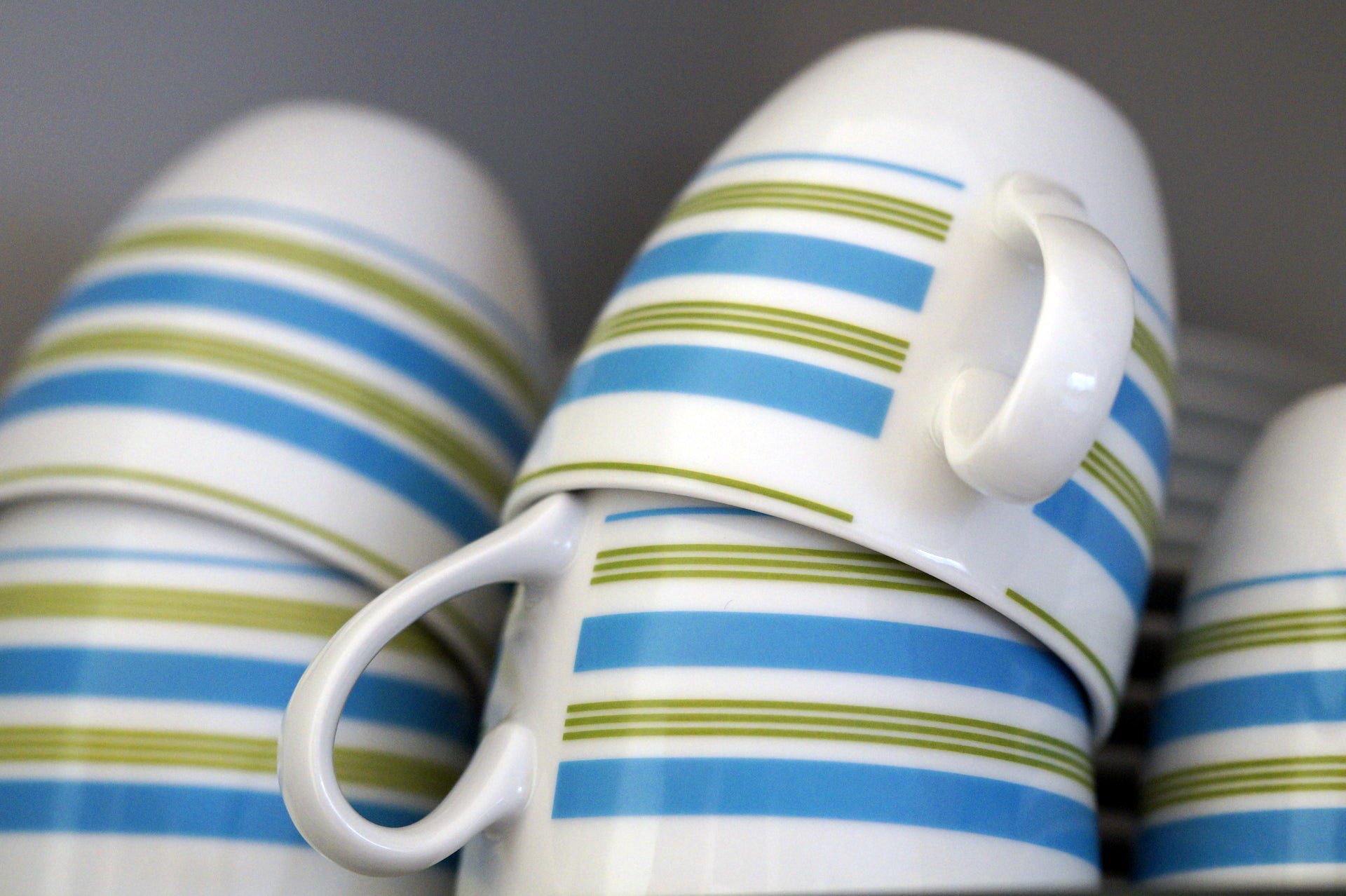
My weird dilemma of the week was a mug. I have an excess of mugs and so I was trying to go through some of my mugs and let them go.
And this was not easy. Obviously I have the brain of a hoarder and every mug I picked up I had a reason I should definitely keep it.
And I was trying to balance that with yeah but you’ve got a reason for every one of these 80 gazillion mugs and you can’t keep them all and yeah that was a nice mug in 2005 but that doesn’t mean you have to keep it now and all of that kind of back-and-forth conversation with myself that I have when I’m trying to persuade myself to be rational about these things and not entirely succeeding.
But a number of mugs are in the charity shop bag and that is good.
But then I came across this one particular mug and this was my dilemma. Because this mug had clearly been hand painted. And not the kind of hand painted that you might buy at a craft fair, more like a friend had a go with some ceramic paint once, that kind of hand painted.
And I have no memory at all of this mug ever having existed in my life. I am pretty sure somebody painted it for me for a birthday, for Christmas, something like that, but I have no association with it and so I don’t know who… I can make a guess based on which of my friends are a crafty, but it would be a guess.
And it’s a weird dilemma on a number of levels. One is I feel I should have an emotional connection to it because somebody put some time and effort into decorating it for me. But the reality is I don’t have an emotional connection to it because I don’t even remember it existing until a few days ago.
And then the other layer of why this is a weird dilemma is I just thought okay well I need to not keep this mug, it doesn’t mean anything to me, it doesn’t look great and I have other mugs I would rather keep.
But then what to do with it? Because on the one hand, all the other mugs I was getting rid of – I say that as if there are millions of them, the handful of other mugs I was getting rid of were going in the charity shop bag, as long as they weren’t like chipped or cracked or whatever, and that was quite easy.
But I didn’t want to put this one in the charity shop bag for two reasons.
One, as I said, it doesn’t look amazing. I wasn’t sure a charity shop would want to sell it. If I had an association with who it was from and could think oh such and such painted that for me, then I would probably appreciate it more. But going to a stranger in a charity shop based on how it looked, nobody would have looked at it and had that association.
I do apologise to whoever made it for me, it’s really not like me to forget that kind of thing!
But anyway.
And the other reason I didn’t want to give it to the charity shop was: what if that friend who made it for me went charity shopping and saw it on sale and recognised it and said, I painted that for That Hoarder and now she’s given it away that’s really rude and horrible.
And that would upset them and it wouldn’t make me look good.
And so that was two pretty solid reasons to not give it to a charity shop.
So then my instinct was oh well I’ve got to keep it then.
And thankfully I’ve been challenging the this stuff in my head and learning so much over all this time that I did not accept that as a final decision. Because I reminded myself that I didn’t want it, that remains true.
Even if it shouldn’t go to the charity shop I didn’t want it.
So what to do?
And what I did – I’m sure some people will find difficult, I found it difficult – but I put it in the bin. I threw it out.
And I’m okay with that. I don’t love it, I don’t love that that’s what I did, but equally I can’t see any other great solution to that very specific situation.
So that was my weird dilemma this week and it was quite weird and quite a dilemma. But it is now in the bin.
Sorry again to whoever made it for me!
So, freebies! These are really difficult for a lot of people – especially hoarders – to deal with.
If something is cheap, I find it very difficult to resist buying it. So you can imagine how tempted I am if something has no cost whatsoever, if it is absolutely free, I find it so difficult to say no. Share on XNow if you’ve listened for any amount of time, you know that one of my triggers for acquiring is a bargain. If something is cheap, if something is unusually cheap, if something feels like a really good deal I find it very very difficult to resist buying it.
So you can imagine how tempted I am if something has no cost whatsoever. If it is absolutely free, I find it so difficult to say no.
And as we know from the Endowment Effect, if you take ownership of something, whether it’s a car or a house or a pen or a mug, you automatically value it more highly than if you didn’t own it.
That is a well-documented phenomenon and so you might take the freebie thinking I will get rid of it later, but the Endowment Effect tells us that you probably won’t.
And the Endowment Effect on top of hoarding disorder really does tell you that you’re going to keep this thing if you take it.
I used to be really into competitions. You know in the days where you would send off a postcard as a competition entry? There would sometimes be like a question you’ve got to answer the question and then you send off a postcard to an address and there are prizes.
And I was really into this for a while and I loved the randomness of winning the occasional thing, it was quite a nice hobby – I won a TV once, a whole television which obviously that was by far the biggest thing I won. And then and then all kinds of other randomness.
And it was really exciting when you got an unexpected little parcel in the post and it contained something that you hadn’t bought, it had cost you essentially the price of a postage stamp and I loved that.
But the thing about competitions is that nearly always there is a big prize, which is what you’re entering for and then there are 200 runner-up prizes, 200 second prizes, and then like a thousand vouchers for money off for runner-up runner-ups.
And so it’s very very rare for you to win the TV or the holiday and it’s a lot more common to get the second prize. And you didn’t enter for the second prize and you probably don’t want the second prize.
There was one period during my competitions phase when I got second prize in three separate competitions and won the same fish cookbook three times.
And I wouldn’t have wanted it once to be honest, it was so random, the reason it sticks in my mind is because the foreward at the beginning of the book was written by Sarah Palin, that American politician which is another aspect of randomness about it, that’s why I remember.
But what do you do with three copies of a fish cookbook? They all went to the charity shop and somebody else could read Sarah Palin’s thoughts on fish cookery.
But again other than things like that, getting a freebie in the post because of a competition, you also felt a bit a bit special. Like I won! Even just the language, I won, that sounds really really cool.
There are also forums online where that are just dedicated to freebies that you can get.
If a website that sells tea is offering a free tea bag if you just send them your name and address then it will be listed on that forum. And if an insurance website is offering a free pen if you send off for a quote then it will be listed on that forum.
And there are people who spend their days just going through these forums getting every freebie they can.
And the thing is, which I will go into in more depth later, but the thing is the companies don’t do this out of the goodness of their own heart. They do it because it’s part of a wider marketing strategy.
And one of the results of sending off for freebies like this is that you then end up on about a thousand different mailing lists. And so yeah, you might get a free pen or a free tea bag but the junk mail coming into your house is multiplied by 10, it’s a real problem.
And I went on holiday a couple of months ago, I just went to the seaside and it was lovely and there was a kettle in my hotel room and there were tea bags and little coffee sachets and little pots of milk and sachets of sugar all provided.
Now I don’t drink coffee and I don’t take sugar in my tea. And so I used the tea bags when I was there and then when I was coming home I thought, well I may as well take with me the remaining tea bags. It was even Yorkshire tea which is the best breakfast tea, so it was the tea I drink anyway.
So that was perfect, that was an obvious thing, I will bring home the free tea bags.
But I also brought home the free coffee sachets and the free sugar sachets.
And it’s not just that I don’t drink coffee, it’s that I don’t have guests around who do! My house is not in a state to have guests.
And so I now have these sachets of coffee and sachets of sugar – and you can’t do anything else with those sachets of sugar, it’s like a teaspoon of sugar and so there’s nothing useful you can do with them.
And it feels wasteful to throw them away and I knew that if I left them in the hotel room they’d be thrown away and replaced with new ones. Inexplicably. I guess some kind of health and safety concern.
But I have those now in my kitchen for no reason at all and even if I did have guests I would buy them nicer coffee than that.
I went to the dentist and at the end of the appointment when I was paying my bill, I was offered some free mouthwash and I was like oh yeah that would be great, yes please. And I went home with these mini bottles of free mouthwash thinking I’d got a bargain when I’d actually just paid them 50 pounds for the privilege. But it felt like a win.
Flyers! I used to pick up flyers relentlessly, I could not leave a leaflet alone. And I don’t I still don’t fully know why I was so persistent with that but I really was. I had a house full of flyers.
I don’t do that now, it’s not even something I have to resist now. I don’t understand why I was so obsessed with it for a while but I was.
And it was partly because they were free and it was partly because they were information and I like information.
And then the other obvious one is when you go to a conference, when you go to an event, every stall has free pens or free bags or free fidget spinners.
It’s so hard to resist those because part of you is thinking that it’s always handy to have a spare pen in your bag. And it is! But once you’ve got round the conference hall and you’ve got 20 spare pens and 18 of them don’t work and they’re not pretty and they don’t write very nicely, you do wonder kind of what you’re doing with your life.
And so that I feel like when I started exploring my experience of freebies, I realised it’s quite extensive in the context of my hoarding, I’m really really quite a freebie seeker.
And that is stuff that all ends up staying in my house for a really long time.
And it’s something that I need to address more effectively.
So why do we love freebies? There is a Turkish proverb, allegedly, that says ‘Vinegar that is free is sweeter than honey’.
And we know that feeling don’t we? If something is free we feel an extra boost, we feel like we’ve won something. And this is a good example of that because this is a known phenomenon and if we get a free mug with particular branding on it and we look at that mug and think yay I got a freebie! Then we create in our brains a positive association with that brand and then, when we’re next in the supermarket and we see that brand on the shelf, our brain goes oh that brand makes you feel really good. And that has an effect on the choices we make in the future.
I know if I see a freebie on the side of the road for instance, somebody’s left an old table out to be collected and it’s just there, I can find that quite hard to resist. I don’t tend to stop and pick that kind of thing up, although I do obsess over it and have to do a lot of work in order to leave it behind.
But whether something is free from a corporation or free because it’s on the side of the road or free because one of your friends says I’m about to throw this away would you like it? It feels good, it feels like a win.
And there is no risk with a freebie like there is with buying something.
When we are giving money for something, we have expectations in return.
If we are buying food we expect it to be fresh and taste nice and have some degree of nutrition in it. If somebody gives us a freebie, we don’t mind so much if it doesn’t taste great because we didn’t pay for it.
It’s like if there’s a well-established brand, say of a fruit juice and you know the brand but they bring out a new flavour of fruit juice, then quite often in the city centre or in the supermarket, they might give out free mini cans of this new flavour of fruit juice.
Because they know that if you are doing your shopping and you’re looking on the shelves and you think oh they’ve brought out a mango flavour, I wonder if that’s nice or not, you might think it’s not worth the risk, I don’t want to spend money on it in case I actually don’t like it.
Whereas if they give you a free sample of the mango fruit juice, you can take it home and if you don’t like it you’d never have to buy it again and you’ve not lost anything. If you do like it then next time you’re in the shop, you pick some up.
We have lower standards because we’re not making an investment in getting it.
Because whenever we buy things we make calculations, almost like a risk assessment.
If we are dissatisfied with this, how will that feel? And if we’ve paid money for it, whether it’s a lot or a little, that dissatisfaction will be bigger if we don’t like it.
And a lot of freebies from businesses rely on a principle called reciprocity, which is where if somebody gives you something or if somebody does something for you, you feel an obligation to give them something back or do something for them in return.
And there is a guy called Dan Ariely, who has done a lot of really interesting research into… I don’t know whether it would be behavioural psychology or behavioural economics, those kinds of areas.
And he wrote a book called Predictably Irrational and talked about the principle of reciprocity in there.
And it’s an instinct that’s very very hard to resist and often we reciprocate in a bigger way than what we got in the first place.
If somebody does you a small favour you are more likely to react by doing them a big favour.
And businesses and people might rely on this by doing a small favour for you, giving you a small sample of something, in the hope and knowledge that in return you will give them something more.
And this is really powerful and partly that’s a good thing, it’s good that humans have some kind of instinct to reciprocate good deeds because that leads to a nicer society.
But it’s bad when marketers in particular but also shady individuals, know that this is the case and exploit it.
And it’s one of those things that once you become aware of it, you’ll start seeing it everywhere around you.
And then there’s something called the zero price effect which is a phenomenon where we are more likely to buy something if it has a free element, even if the free element is not that impressive, even if it’s not very much, even if it’s not worth much.
And I have definitely fallen for this a lot.
If I am buying… I know it happens a lot with makeup. I might be buying some mascara and then the sales assistant will say oh if you buy a lipstick and a mascara then you get a free eyeliner.
And I will go oh, a free eyeliner!
Even though I don’t want lipstick, I so rarely wear makeup that I probably don’t need eyeliner either, and all I wanted was a mascara for eight pounds and I end up spending 22 pounds in order to get a free eyeliner worth one pound, none of which I needed except maybe the mascara, maybe.
Or, a friend noticed this year that this very rarely happens anymore but it used to be at Easter that one of the very common kind of formats of Easter eggs – is that a thing? – was you would get an Easter egg and a free mug and the mug would be branded with Cadbury’s dairy milk or whatever kind of egg you were buying.
I got so many Easter eggs on the basis of the free mug, even though they weren’t great mugs. I didn’t want to drink out of a mug branded with Cadbury’s dairy milk – much as I enjoy a Cadbury’s dairy milk that’s not what I want from my mug.
And yet it was free – and of course it’s not free, it’s included in the price, Cadbury’s aren’t doing us a favour and subsidising mugs for the sake of the good of the nation.
Cadbury’s know that people buy the Easter eggs that have mugs – other chocolate brands are available.
As soon as there is a freebie, we all lose our collective minds and spend three times more than we’d originally planned to because we could get the cheap shampoo or the expensive shampoo but the expensive shampoo comes with a tiny tiny comb that is not practical but it’s free.
And so we could have spent two pounds on cheap shampoo and so we spent eight pounds on posh shampoo with a comb that’s too useless to ever use. Just because the comb was there and sellotaped to the packet.
And the thinking is that one of the reasons the zero price effect is so powerful on us as consumers is that when we’re making a purchasing decision, we’re kind we’re balancing all these different kinds of decisions.
Os it worth the financial cost? Is it worth the amount of effort it will take to get this thing? Will it benefit us sufficiently to be worth the financial cost and the effort it takes?
But as soon as there’s a freebie added, something that has no cost at all, the thought is that we kind of step out of our usual decision-making process and we stop balancing costs and benefits in our mind and we… the way this article I want I read the way one article I read about this describes it is our perception becomes distorted. We magnify the item’s benefits and ignore possible downsides.
Let’s try something new. I’ve had an idea for a new segment for the podcast, and it involves you! Introducing… listener voicemails!
Go to https://www.overcomecompulsivehoarding.co.uk/voicemail and leave me a brief recording to play on future podcast episodes.
Let’s have a go and see how it works! Let us know what you’re thinking at https://www.overcomecompulsivehoarding.co.uk/voicemail
And another area of thinking about the zero price effect as well as that thing about bypassing our usual decision making process is the way we look at items if there is a free element.
So if we are considering buying something regular, we have a transactional mindset: what am I going to get and what am I going to give? I will give Tesco 50p and I will get three potatoes.
But if something is free or if there is a free element to something, rather than thinking transactionally, we become more affected by our emotional response.
So instead of a transactional mindset we have a social mindset.
And it goes even further. There’s been further research that shows that different kinds of products affect us differently if they are priced at zero.
So there was a study in 2015 that they that divided products up into hedonistic products and utilitarian products.
Hedonistic products are products that are fun, that we buy to entertain ourselves or to make ourselves happy. And utilitarian products are useful, practical, necessary, functional, that kind of thing.
So a hedonistic product would be a bath bomb, a utilitarian product would be a toilet brush.
And so these researchers, Hossain and Saini, found that the zero price effect is more pronounced for hedonistic products, that’s products that we get for fun, than it is for utilitarian products.
We are much happier getting a free cake than we are getting a free bag of flour. Cake is fun and hedonistic, flour is utilitarian and practical.
And so the emotional decision making, which we know the zero price effect can key into, the emotional decision making is more powerful for hedonistic products because we relate to them in a in an emotional way to a degree.
So when a company is presenting a freebie they might have different motivations for this.
They might want just brand recognition, they might just want us to recognise a brand and be familiar with it. They might want us to have a good association with that brand. They might want us to test something new and then be more likely to buy it. They might have a product that’s not selling brilliantly so they add a little freebie to it and it flies off the shelves. They might want people to feel like they’re part of something and if they’ve got the special free bag that a bar was only giving away on their opening day, then you’re part of oh I was there, I was there the day that bar opened.
There’s all kinds of reasons for brands in particular to give us freebies. And there are all kinds of reasons for people to give us freebies as well.
Some people inadvertently give us freebies by leaving something out on the street for collection and then you intercept that collection and take it.
Other people deliberately give out freebies by saying oh my kid’s grown out of these clothes do you want them for your kid? Or by saying I bought two of these by mistake or I got two copies of this book for my birthday, do you want one?
And that can have different purposes as well. That can be purely practical, they don’t need two copies of that book, they want to get rid of one of them and you’re there and they offer it to you. Or they know that you’re interested in that topic and they offer it to you. And they want the space and they don’t want the hassle.
Some people, especially if you have other people in your life who hoard, be that family members or acquaintances or friends, those people can be tricky for giving things away for free and I know that because I have to resist giving my things to friends.
Because for me it’s a win-win situation, I am able to make some space in my home but I can have that faith and confidence that the thing I’ve given away is going to be well used or well looked after.
But the thing is that is quite a selfish thing, often. If something is genuinely ideal for your friend then that’s all good.
But if you’re turning up at your friend’s house or your mum’s house with bags and bags of things just so you could get them out of your house, that’s not really… you’re just diverting the problem to their house. You’re not actually solving the problem of too much stuff, you’re just moving your stuff to somebody else’s house and then they have to deal with it.
So if you have hoarders in your life, they may have that motivation for trying to give you free things as well.
So with all of that in mind about the different reasons we fall for freebies and we want them so strongly, I’m going to now talk about how we can resist freebies. And first of all I am going to talk about freebies from companies and then I am going to talk about more what people might consider more true freebies. And then I’m going to talk about freebies in general and how we can resist them all.
‘We often pay too much when we pay nothing’ - @danariely Share on XSo Dan Ariely, whose book I mentioned earlier, he said ‘We often pay too much when we pay nothing’ and that is what we need to keep in mind.
So I’m going to talk about things to keep in mind when there is a freebie from a company available and keeping these things in mind might just help to reduce the attractiveness of that free thing.
So the first thing, as that Dan Ariely quote suggested, is that freebies are not always free.
For instance, buy one get one free items, you still have to buy one!
I can’t tell you the number of times I’ve got home with a three for two offer and then realised I didn’t want one, never mind three. Or I only wanted one and now I’ve got three.
But also in a less literal way freebies aren’t always free because if in return for the freebie you’re giving out your personal information, for instance if you’re giving your address to get a freebie sent in the post, that data is worth more than some plastic bit of nonsense that comes in the post.
Because if your data was worth less than the plastic bit of nonsense that comes in the post, the company would not be offering the freebie.
And it’s the same with free trials. Some people are very organised and can sign up for a free month of Netflix and remember to cancel it in time. Most people sign up for a free month of Netflix and six months later realise they’ve been paying and paying and paying, either because they’re hooked or because they forgot all about it.
Free trials are designed to suck you in that’s the whole point of them.
And the other thing about free trials is that companies can make it really really difficult to cancel them. You might think I will sign up now and I will cancel before the payment goes out in a month. But some places make it really hard – you have to make a phone call to cancel, you have to send a letter by post, and then if you don’t, you might end up paying 12 months automatically and there’s no way to get it back because somehow by ticking a box you signed a contract.
Another freebie that isn’t a freebie is if you get a voucher – if you buy this now you will get 10 pounds off your next shop worth 40 pounds.
I mean, you hear 10 pounds off and think great! But actually a voucher for 10 pounds off next time you spend 40 pounds means that you’re guaranteeing that shop a further 30 pounds at some point in the future.
That’s not free to you! If you were genuinely… if you go there weekly and always spend 40 pounds then that works. But if you end up making a special second trip just to fulfil the voucher then you’ve been sucked in, And that’s not a nice feeling but it’s true.
Another freebie that isn’t a freebie is if something is free and you just pay postage. Because occasionally that is genuine. Most of the time that postage is suspiciously high.
I had a Facebook ad recently for some free vegan chocolate bars, just pay postage. Now, yes please to chocolate, yes please to free, and to be honest I’m not vegan but I am happy to… I eat plenty of vegan stuff.
And I had had this brand before and I knew that it was really nice chocolate. And so I happily clicked.
But what the deal was, you got four sample size chocolate bars from this place and they were four different flavours and they looked delicious. But the postage and packaging was something like six pounds. And I realised that if those four bars sample size bars were on sale for six pounds, I wouldn’t look at them twice. I would think that’s really expensive for what you’ll get.
And I know it’s nice chocolate and I know it’s a bit posh and I know that vegan chocolate is more expensive than dairy chocolate. But even with all of those things in mind, I would not pay six pounds for this.
And I was able to resist it but I’ve fallen for that many times and it’s a trick we’ve got to be aware of.
And then kind of the opposite of just pay postage is free postage if you spend a certain amount.
And if this makes sense if… if you get free postage when you spend 40 pounds and your shopping cart has 38 pounds’ worth of stuff in it and postage would be five pounds, then of course it makes sense to add something for two pounds and get free postage.
But a lot of the time, admit it, you were planning to buy one thing for 15 pounds. Spending an extra 25 pounds in order to get free postage is not a good deal! It is not!
Another reason it’s not free, any freebie this is, another reason any freebie from a company is not free is the environmental cost.
There is no chance that your average corporation is producing something that is carbon neutral and will go in the compost and disappear.
That’s not how corporations work. So there are wider costs.
So with all of that in mind, when a company is offering a freebie of some kind, try and calculate the true cost of it and see beyond the fact that it has the word FREE in big red letters on it.
Are you paying more for the thing you are paying for in order to get the freebie than you would have paid if there was no freebie? Are you paying more to add extra things to your cart in order to get the free postage? What is the environmental cost of that plastic pen at the conference? What is the environmental cost of that t-shirt with a logo on it that you don’t think looks nice but that has been grown as cotton and picked and turned into a t-shirt and sewed and then printed with goodness knows what. What is the cost of getting exponentially more junk mail just for the sake of that pack of coffee?
Chances are if you can step back and look at the true cost and understand what companies are doing when they’re offering them, which I repeat is not done out of the goodness of their heart, then that can really help to build some resistance in you and build some good arguments for when you’re debating do I get that freebie or not?
And then there are freebies that are things like some shelves that somebody’s left out for the bin men or something that someone’s put up on free cycle or facebook marketplace and said I don’t want any money for this, I just want it gone.
And it’s really tempting to take that stuff.
And one thing to keep in mind with those kind of freebies is that if you take it, that means somebody else can’t take it.
If you take it, somebody who might need it more will not be able to benefit from it.
If there are baby clothes going for free on free cycle and you’re thinking well maybe one day I’ll have a baby and so I better take them, then that poor woman who’s just had a baby and has no money and all the baby clothes that she’d been given as gifts are in the house that she fled from her abusive partner. And now she’s in a hostel with her newborn. She can’t get those baby clothes.
If somebody’s offering a pile of recipe books and you think oh i’d love a pile of recipe books but you know that really you don’t need them, then that new couple who’s just left home and has nothing won’t be able to start their kitchen library – is that a thing? – with those free recipe books because you’ve got them.
If somebody needs some shelves for their kid’s bedroom and there were some shelves on the side of the road but you took them home even though you’re only putting them in the garage because there’s no space in your house for them, then somebody else can’t have those shelves.
And they may have to buy them, which comes at a financial cost to them and an effort cost to them and an environmental cost to the world.
And so it’s something that we don’t like to think about. And if we genuinely need something, we often feel guilty don’t we? Oh I shouldn’t take this because what if someone else needs it?
But if we don’t need it, often that guilt isn’t there and it’s really back to front.
And then the other reasons not to take freebies, whether they are corporate freebies or freebies on the side of the road or freebies from a friend or freebies from free cycle, is the cost to you. Not in money because they were free, but because you pay in other ways.
You lose space in your home and if you’re a hoarder you’ve already got precious little of that.
But you lose time when you’ve got so many things that you can’t find anything. You lose time the more stuff there is to search through for your keys or for your passport or for that gas bill that you know you haven’t paid.
And it costs you energy and… physical energy and emotional energy. Working out where do I keep it? What do I do with it?
It needs space in your brain somewhere. And life is exhausting already and so having to expend extra energy dealing with whatever the new freebie is, whether it’s a big thing or a small thing, it all adds up to a really exhausting situation.
And then you’ve got that stuff, which you then have to dehoard at some point. And whether it’s tomorrow or whether it’s in 10 years, that shelving unit that never left the garage because you didn’t need it in the first place or you did need it in the first place but you didn’t have space for it and now it’s damaged because it’s been squashed by so much other stuff. And now you’ve got to deal with it, having not had any benefit from the thing and only had woes from it, that is all stuff that future you does not need.
When Tracy McCubbin was on the podcast, she shared a quote she’d heard that was something along the lines of: your home is not a graveyard for other people’s stuff, your home… oh no that was a museum, I don’t know where the graveyard quote came from.
But your home is not a museum for other people’s stuff and your home is not a graveyard.
You deserve to live in a home that you can move around easily and that you can find things in. Share on XAnd you deserve to live in a home that you can move around easily and that you can find things in.
And the more freebies you get, because you get a little dopamine hit and because you get a buzz and because you feel special and because you feel like you’ve got a bargain, the more of those freebies you take in, the more of that emotional and physical labour it takes up at some point in the future, whether that’s soon or whether that’s years down the line, you still have to deal with it.
You’ve still got that extra t-shirt, that extra bag, that extra keyring – my goodness if you saw my keyring collection! Why? I do not know! But I have millions and at some point I’m going to have to deal with them and who wants second-hand keyrings? Very few people.
So they’re probably going to go in the bin, which is going to make me feel miserable, which is probably why I haven’t dealt with them in the first place and a good number of those keyrings were probably free. let’s face it. I don’t know, I don’t often remember buying keyrings and yet I have so many of them.
So just because something looks free doesn’t mean it is.
Because it’s not all about the money you hand over for something. But in some cases the money you hand over for something does go up because you think you’re getting a freebie and actually you’re paying more than what you would have done if there was no freebie involved.
I’d love to know your techniques for resisting freebies. If there is anything I haven’t covered, contact me on social media all the links at overcomecompulsivehoarding.co.uk
I would love as many tips as you’ve got.
Let’s talk secrets. I keep my hoarding secret, and I often wonder about the effect that these secrets and this shame has on us and our mental health. To start breaking the taboo, I want to hear your hoarding secrets to discuss anonymously on the podcast.
I’ve created a form to submit your secrets anonymously – I won’t know who sends what. If you want to tell me your secret for a potential future episode, go to https://www.overcomecompulsivehoarding.co.uk/secret
So my top tip this week is a little clip from the Frugal Friends podcast, which is one I enjoy. I will link to it in the show notes as always.
And it’s just a few seconds about recognising when you are in a cycle of behaviour that is not serving you. And then once you’ve recognised it, how to interrupt that cycle of behaviour:
I mean just recognising cycles and patterns of behaviour and where to interrupt them.
Sometimes it can help us even draw it out, like literally draw out a circle and identify like, Where does it start? What happens next? What happens next? What happens next? What’s the end? How does it then get back into the cycle again?
And then once we have that written out around the circle, identifying Where can this be interrupted at what point do I want to interrupt it and how and with what can I interrupt it?
And just begin practising changing and shifting some of those learned behaviours.
And as a big fan of getting a big piece of paper and a pen and getting everything out of your head onto the big piece of paper, that is a technique I approve of.
Okay, thank you for listening and I will speak to you next time.
Thank you for listening to the Overcome Compulsive Hoarding with That Hoarder podcast. You can find more online at overcomecompulsivehoarding.co.uk
You can find me on Twitter @ThatHoarder. And on Facebook at Overcome Compulsive Hoarding with That Hoarder.
To find out more about how you can support this podcast and the overall project, go to overcomecompulsivehoarding.co.uk/support and do subscribe to this podcast, so you make sure you don’t miss any future episodes.
There may be links in this podcast that earn me money. This doesn’t come at any extra cost to you if you make a purchase through those links and it helps to support the future of the podcast.
Image: Pixabay