Show notes
- 10 Principles of Intuitive Eating
- What is intuitive eating? Beginners guide to the intuitive eating principles
- The Health at Every Size® (HAES®) Approach
- Podcast ep 12: “But throwing it away would be a waste of money”: defeating objections to dehoarding
- 18 Tricks to Make New Habits Stick
- Website: Overcome Compulsive Hoarding
- Twitter: @ThatHoarder
- Facebook: Overcome Compulsive Hoarding with That Hoarder
- YouTube: Overcome Compulsive Hoarding with That Hoarder
- Reddit: Overcome Compulsive Hoarding with That Hoarder subreddit
- Help out: Support this project
- Sponsor the podcast
Subscribe
- Apple Podcasts / iTunes
- Google Podcasts
- Spotify
- RSS
- iHeartRadio
- Amazon Music
- Audible
- Stitcher
- Podchaser
- Pandora
- Deezer
- Podcast Addict
- Player FM
- Podcast Index
- TuneIn and Alexa
- Castro
Audio credits
- Intro and outro music: grapelemon
- Ding dong: MatthewWong
- Hallelujah chorus: deleted_user_2906614
- Transition whoosh: Vilkas_Sound
- Uh oh: stib
- Applause: Sandermotions
Transcript
Welcome to the Overcome Compulsive Hoarding with That Hoarder podcast. I am drowning in stuff and trying to find a way out. Listen as I explore the issues and delve deep, as somebody profoundly affected by hoarding disorder. Find out more, including links to subscribe to the podcast, at overcomecompulsivehoarding.co.uk and find the links there to follow me on Twitter, Facebook, Reddit and all over the place.
So I’m going to start this week with a call for questions. A few people have asked me whether I would do a Q&A episode, where listeners send in questions and I answer them. And I think this is a great idea, but it depends on you sending me questions!
I’ve already had a few, which is brilliant. But send over anything you’ve been wondering about, anything you’d like to know. And I’ll see what I can do.
There are different ways to contact me. My email address is info@overcomecompulsivehoarding.co.uk. I am @ThatHoarder on Twitter. I am ThatHoarder on Reddit. I am also on Facebook, on YouTube. And you can even contact me through I never know how to say it Kofi? Coffee? https://ko-fi.com/thathoarder.
So if you’ve been wondering about anything, just drop me a line, and I will do my best to answer.
So I’m also going to start this week with a dip into my occasional series where I share a success of the week, and a weird dilemma of the week.
So the success of the week I share to encourage listeners, and also to encourage myself, keep myself accountable, all of those good things. And my success of the week is that I am finishing things. [Hallelujah]
I am finishing rolls of binbags, I’m finishing bars of soap. Normally, say with rolls of binbags, or the same applies to pens, or anything that can run out, I lose it long before it could possibly run out. I use three bags of a roll of binbags and then don’t see that roll again for six months. Or I use a pen a couple of times and then lose it.
With something like bars or so bottles of shampoo, that kind of thing, I tend to not finish those because I have this need for newness, I need a new scent when I wash my hands, I need a different kind of shampoo. And I therefore have four or five or 10 on the go… no I don’t think I’ve ever had 10. But, you know, I have so many on the go at once – because I can’t stick to one thing – that I never get to the end of any of them.
And since I’ve been making a more concerted effort to live in a smaller amounts of chaos, I have made rules for myself about things like soap and shampoo. I am allowed, I can only have one bar of soap open for each, kind of, sink. So I have a bar of soap on the bathroom sink and a bar of soap on the bath and a bar of soap on the kitchen sink. I’m for each I can only use the one that’s open and I can only have one spare waiting.
So implementing that and being quite strict with myself means I don’t have piles and piles of soaps looking at me appealingly and wanting to be opened. And I am just sticking with one at a time.
With things like binbags and pens, it’s a couple of things. One, I’m being more consistent in my work, so I’m using bin bags more often. So it’s easier to know where they are. But also, I have places for things, which I never did or not, not consistently, not long-term ones, not ones I stuck with. But as I am working really hard to find places for things, it’s easier to find them so I don’t lose them. So I do get to the end of rolls of bin bags. I do get to the end of the ink in a pen. I do get to the end of all that kind of thing.
So that is my success of the week. [Applause]
My weird dilemma of the week was a spare button that came with a new pair of jeans. [Uh oh]
You know, sometimes, things come with a little button, just in case you lose the button on the item. Now, I have occasionally repaired clothing in the past, but not for ages and ages and ages. Plus, I’ve never successfully sewn on denim, denim is harder to sew on than the things I have sewed in the past. So I knew that I shouldn’t keep the button because realistically, if the button did pop off my jeans, I know I wouldn’t repair it. I know, deep in my soul. I know.
So the dilemma was what to then do with it. I could throw it away, but that felt wasteful and painful and wrong. I couldn’t sell it. Nobody wants to buy one button. Or I could give it away or I could donate it. Similarly, I didn’t think of any of my friends and think, you know who needs one button? [Laughs] Jill! Jill’s always after single buttons. So I knew it wasn’t something to give away.
So the other option was charity shop. And in the end, I did put it in the charity shop bag. And my reasoning is that in the past when… I’ve had to pretty much stopped going to charity shops because they’re a real place I can’t resist buying stuff. So this is all based on a few years ago, but they quite often would have a tin full of buttons that crafty people could rifle through and choose one or choose 10 for their latest project.
So on the basis that they may still have tins of buttons for crafty people to rifle through, I did donate it to the charity shop.
I’m not 100% proud of that decision, if I’m honest. I’m not sure it was the right thing to do. I suspect I should have thrown it away. But equally it’s not a massive thing for them to throw away if they don’t have a button collection for sale.
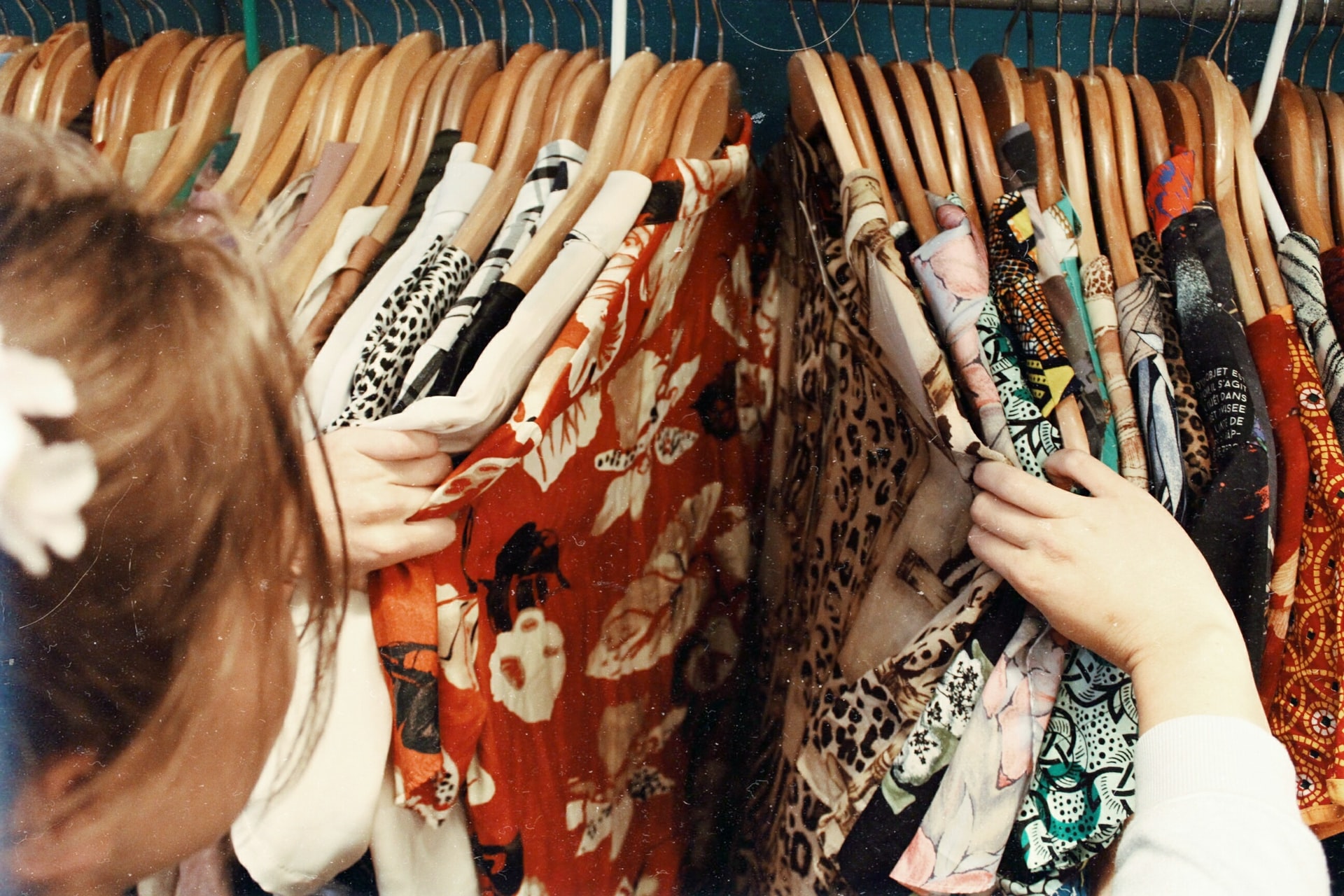
So today I’m going to talk about what to do with clothes that don’t fit. And there are a number of options available to you.
I suspect that you like me have a whole range of clothes in a whole range of sizes. And there are other issues with clothes: you may have things that do fit but you don’t particularly like, or that do fit but they are office wear, and you work from home now, or any of those things.
But today, we’re specifically looking at clothes that don’t fit.
Now, some people have been the same weight and clothes size since they were 18 and don’t really have this issue. Maybe they have some old pregnancy clothes that don’t fit. Or maybe they briefly went up a size or down a size. But the vast majority of their things are absolutely fine for them.
For those, this episode may not be so relevant, but you may still pick up some tips that you can learn and apply in other areas of your dehoarding.
But for those of us like me, whose size goes up and down and down, and up and up and down, and down and up, you can end up with a whole load of clothing. And you feel you have to keep it because your weight is invariably going to go up or down or down or up again, because that’s just what your body does. And it’s completely normal and natural and fine.
But what do you do? Do you really need to keep five sizes worth of everything? That’s what I’m going to talk about today.
If you're currently a size 14, but you have been a 10 or 12 or 16 and an 18, you don't need clothes for every occasion in all of those sizes. You don't. Share on XSo first of all, no, you do not have to keep five sizes worth of everything. If you’re currently a size 14, but you have been a 10 or 12 or 16 and an 18, you don’t need clothes for every occasion in all of those sizes. You don’t. Listen to me, you do not! You don’t have the space, and it’s pointless. And by the time you’re a size 10 or a size 18 again, you probably won’t like some of those clothes or they’ll be really dated, or you won’t do the thing anymore that you associate those clothes with. Perhaps you play golf, but by the time you’ve gained a bit of weight, you won’t be interested in golf anymore, so you don’t need golfing clothes in every size.
So if you start with the size you currently are, you don’t need a million items of clothing even of things that fit you. You need a few casual things, a few formal things, maybe a few specific things like a work uniform, or a tennis kit, or something specific. That’s all fine. You don’t need 80 billion of everything. You might need some gym clothes or a swimming costume. But try and be measured. Try and be measured in the size you’re in.
The sizes you’re not in, first of all… this is a biggie and it may not seem relevant to this podcast. But giving up dieting is a revolutionary thing to do. If you’re keeping things because you’re a size 18 and you want to be a size 12, diets don’t actually work. I say this as somebody overweight who has dieted a lot. If you look at the statistics, 95% of people who diet gain the weight back within two years and most of those, the vast majority of those, gain a bit more than they originally lost.
And that is certainly what’s happened to me many times over. It’s not that you are failing at dieting, the fault is not in you if you can’t diet or if you can’t keep the weight off when you have successfully dated. The fault is in diets, diets do not work.
Like many of you, I have successfully lost weight in the past. But maintaining it is a whole other matter. And again, if you can’t do that, that’s not a you failing, it’s a failing in the whole design of diets.
So if you are holding off doing things until you’ve lost weight, you need to stop that. If you want to go swimming but you feel you can’t go swimming until you are a size 10, forget that and go swimming. If you don’t want to go to the gym because you’re a size 22, forget that. Just go.
Do things now! Don’t live now in a way that is just waiting to live when you’ve lost weight. You may lose weight, you may even be part of the 5% who can keep it off. But chances are you’re not.
Diets don’t work. So the first thing I would say is if you’re holding on to clothes that don’t fit cecause you want to diet your way back into them, you’re losing the battle already. So it’s a big ask. But consider stopping dieting. It makes no difference.
If you want to know more about that Google something called intuitive eating. I’ll put some links in the show notes at overcomecompulsivehoarding.co.uk and Google Health at Every Size.
It doesn’t have to be that you’re really unhealthy even if you’re a higher weight than your doctor may be happy with.
I wasn’t planning on going that particular tangent but it is important because it is a reason a lot of people hold on to clothes that don’t fit. And that even if they dieted, and even if they dieted successfully, they might not fit into for a year or two years, if they have a lot of weight to lose.
Put that to one side. If you do somehow lose weight, you can celebrate by buying a few new outfits then. For now, forget that as a motivation.
The next thing is the next. The next point is for people like me, and like many women in particular that I have known throughout my life: if your weight does vary, perhaps it varies at different times of the month. Perhaps it varies on a bigger scale than that over each year, you might gain a bit in the winter and lose a bit in the summer, that kind of thing, then you’ll be understandably wary of getting rid of everything when you know that, chances are, you’ll need to wear clothes in a bigger or smaller size at some point within, say, six months. And that’s fair.
But the point is, you don’t have to keep everything.
What you actually need is sufficient things that fit you now, not excessive, but enough. And then I would say two outfits in one size below, and two outfits in one size above. So… and by two outfits, I literally mean a top and a bottoms. So a pair of trousers and a t-shirt, and a skirt and a jumper. Let’s say that for your two outfits.
Whatever you’re comfortable in. For you, it might be jogging bottoms, it might be pencil skirts, it might be party dresses, whatever you wear the most.
That’s important, because what I’m talking about is if you do gain or lose weight and you change clothes size, you want to have something that fits because it’s pretty miserable to wear clothes that don’t fit. It’s uncomfortable. Either things are falling down or they’re too tight and neither of those are any fun.
So what I want is that if you gain or lose weight, you have something you can put on and then, should that happen, then you have something you can wear or when you go to a charity shop or a supermarket or a clothes store, or wherever you buy your clothes, where you can pick up a few extras for the time being.
It may seem wasteful, but what is actually wasteful – and I’m trying to learn this one myself – you might spend a few extra pounds or dollars but is that worse than wasting a vast amount of your space at home when you could have that space and use it and love it, and not trip over things, and not step over things and not avoid whole rooms?
If you consider spending, say, £200 on an entire new wardrobe. That may be ambitious, it may not be, depends where you shop, depends how much clothes costing your country, and it depends what you consider a whole wardrobe to be. But it’s just an example number.
Is that £200 worth half of your entire bedroom? I don’t know if it is. I don’t think it is for me.
And it’s not like once I’ve got sufficient clothes that fit me, I never ever want to buy clothes again. I quite often want to buy clothes. And so it’s not like if I don’t throw things away or get rid of things, I will never buy clothes again, I will. And so you would be buying new clothes in your new size anyway. So it makes little difference if you get rid of a lot of things that don’t fit you now.
I hope that makes sense. What I’m saying is if you’re the kind of person who periodically buys new clothes anyway, you’re not the kind of person who’s worn the same band t-shirts since the 80s, then you are a person who buys new clothes. And so if you change sizes, you can continue buying new clothes. You don’t need to have a stash of one of everything or 10 of everything in every size to cover you.
So to recap in your size, you want sufficient clothes. Not excessive, but you want things you can relax in, you want things you can party in, you want things you can work in, you want things you can do sports in, that kind of thing.
If you don’t party, that’s fine. You don’t need party clothes. If you don’t go to the gym, great. You don’t need gym clothes. But you see what I’m getting at. And by proportionally if you do party but twice a year, you don’t need eight party dresses. Whereas if you party every Friday and every Saturday, maybe you do.
So think proportionally about your own life. And be honest: don't convince yourself that you go to the gym every day so that you could buy that cute new tracksuit when, in reality, you don't even remember which gym you're subscribed to… Share on XSo think proportionally about your own life. And be honest: don’t convince yourself that you go to the gym every day so that you could buy that cute new tracksuit you’ve just seen when, in reality, you don’t even remember which gym you’re subscribed to it’s that long since you’ve been.
Be honest. Be honest with yourself, ultimately.
So you’ve got sufficient in what you what fits you and in one size on each side, you have two outfits that fit. And if you have more dramatic weight gain and loss than that regularly, then maybe two sizes down, have one outfit that fits or something that’s really stretchy so that you can get away with it for a while.
I don’t want you to be uncomfortable in what you wear. But I also don’t want your home to be an uncomfortable place because of feeling like you need to be prepared for what if you’re a size 10 again, when you currently a size 24. Or what if you’re a size 28 again when you’re currently a size 14.
Proportionality, keep that in mind at all times. I’m making a mental note of it myself.
So, right, let’s get forward and say that you’ve sorted through all your clothes, you’ve got those basics that I suggest you keep. And the rest of it, you have bags and bags and bags probably. Am I just projecting?
But anyway, you have bags and bags and bags of clothes, what do you do with them?
You probably feel like you want to take care of them, you don’t want to throw them in the bin. But there’ll be some that need to go in the bin. They are the things that are torn, or that have a big stain on or that are just so worn that realistically they have no chance of a second life somewhere else.
If you really don’t want to throw them out, consider cutting them up and using them as rags in the house. But don’t end up with a whole cupboard full of cut-up clothes as rags, that’s just transferring the problem from your bedroom to your kitchen or your bathroom or wherever they end up.
Again, proportionality.
Something else: you might be a crafty person, you might be able to fix clothes, which is brilliant. But only keep things – I would suggest – if you’re going to fix them, only keep things that you are definitely going to fix within two weeks. If it’s going to take you longer than two weeks to fix them, then they have to go. Because again, you don’t want to transfer your pile of too many clothes to a pile of sewing that you will never get round to. Give yourself a two week limit and if it’s not done after, then you throw it out. And if you know realistically you won’t get it done within two weeks, you throw it out.
Same with any kind of upcycling. Sure, you can turn jeans into a skirt, but will you turn jeans into a skirt? If you will, within two weeks, keep them with a strict two-week deadline.
The next option is to sell them. Now this can be a great idea, especially if you have designer clothes, or particularly sought-after vintage clothes, that kind of thing. It can be a great option, but only if you actually sell them. Again, a pile in your bedroom transferring to a pile to be listed on eBay is still a pile in your house.
What you actually have to do is sell them. And if realistically you’re not going to sell them, whether that’s to a local shop that buys vintage clothes or designer clothes, or on eBay or Depop, or any of those websites where you can sell second-hand stuff, if you get them listed and sold within two weeks, great. If it takes longer than that, or if you know it’s going to take longer than that, then you have to get rid of that as an option.
And also be realistic about what people might want. Again, if it’s likely to be sought after, like designer stuff, and good vintage stuff, it might have a chance. If it’s a five-year-old t-shirt from Primark (Primark for international listeners is like a really cheap, mass-produced clothes shop. It’s got nice stuff, but not stuff that lasts and it’s so cheap in the first place that there’s little point selling it on). So if it’s from somewhere like that, why would someone buy that? Why would someone take the time to buy that when Primark still exists, and they can get a new T shirt for £3?
So if you’re going to sell things, give yourself a strict time limit of two weeks and only choose to sell things that realistically will be worth the time, and the trip to the post office, and the hassle of wrapping things and all of that.
So if things do not fall into that category, your next idea is a charity shop or Goodwill.
You put your stuff in bags, you drop it off with a warm fuzzy feeling inside, because they are going to, first of all, earn some money because of you. So your excess clothes are going to help fund cancer research or arthritis research, or a children’s hospice. And you can feel great about that. And you can also feel reassured that those clothes are going to someone else who really want them. And so it’s not wasteful. It’s a situation where that t-shirt you don’t love any more, or those trousers that don’t fit, go to somebody who does love them and who they fit perfectly.
So you can feel nice and warm and fuzzy for both of those reasons.
Another option is to give them away to people you know. And this can be really good, but only on very specific occasions.
If one of your friends has seen you wear a particular cardigan, and every time they see you, they say I love that cardigan so much, I wish it was mine. And then you decided to get rid of it because it doesn’t fit you anymore, give it to that person. That will make them so happy.
If you have a load of maternity clothes, and you’re not pregnant now, and your friend is pregnant, and is same size as you and is really broke and can’t afford a whole new wardrobe just to cover six months of their life, pass on your maternity clothes and they will be so thankful for that. Because even if it’s not 100% their style or their taste, they have stuff to get them through the next six months that they can then pass on to somebody else.
Those are the occasions when it’s most suitable to give clothes to people you know.
What you must not fall into the trap of doing is just turning up at your mum’s house or your best friend’s house with three bin bags full of things that aren’t really their style or wouldn’t really fit them, or just that they haven’t asked for. Because then that just transfers the problem to them. And that’s not fair.
It’s not fair for you to think “I’m rescuing these clothes from oblivion”. But actually just give the problem someone you love. Especially if they feel like you’re putting pressure on them to keep them and use them when they just might not like them.
Or they might not have problems with proportionality and they might think, but I’ve already got enough skirts for work. I’ve already got enough ties for when I go to church, I don’t need 18 more.
So if you’re going to give things to people, be very selective indeed. Pick maybe one or two items at most. Unless somebody requests a lot of stuff, don’t give them a lot of stuff.
There’s also… there are closed swaps. And this can be worth looking at they are local, they are in-person events. And I guess things are becoming in-person again after Covid for the time being, so they might start up again.
And often, they are fundraising events where you pay £5 to get in and you can bring two bags of clothes and take away two bags of clothes, for instance. So you can drop off all your size 14 things and go home with some size 18 things that will fit you, based on what other people have donated.
Now these can be great because it gives somebody else the chance to love the things that don’t fit you anymore. But they can be dangerous because you’re going home with new stuff. And you may not have the self-control to turn up, drop your bags of clothes off and leave with nothing. Even if you fully intend to.
I have this slightly with charity shops, I always intend to go in and donate stuff and leave without buying anything. And sometimes I manage it, but sometimes I don’t. Charity shops, for me are a real danger area because there’s so many interesting things and they’re so cheap. And you’re doing good, by donating money.
And so clothes swaps can be a danger zone as well. But if you feel confident that you can manage that, that can be something to look up.
And in certain areas… for instance, a lot of clothes swaps are probably… you probably get a lot of regular-sized clothes. So in some areas, there are specially arranged like plus-size clothes swaps, or baby clothes swaps, or maternity clothes swaps. So if you feel like your regular local clothes swap might not know what to do with a lot of size 24 clothes, then look around for a plus-size clothes swap instead.
And given that people can usually leave with as much as they want, this can be a great option for getting your clothes that don’t fit into the hands of people with very little money, who might be able to pay the five pounds to get in that’s a donation to a charity, but wouldn’t be able to buy three bags of clothes.
So you can feel good about that. And certainly, I have a couple of friends that organise them and what they do with any leftover clothes at the end of the day is take them to a charity shop. So things do not go to waste.
So there’s actually loads of options for getting rid of your clothes that don’t fit. The first thing you need to do is the mental work of convincing yourself that it is safe to get rid of clothes that don’t fit. And then the second thing to do is to work out, realistically and practically, which clothes are suited to go where.
The most important thing is that they get out of your house, the most important thing is not to regain the money you spent on them… I’ve done a whole episode on why getting rid of things is not wasting the money you spent on them, so look that up if you’re struggling with that.
It is not a waste of the original money you spent to get rid of things now. You wasted that money when you bought the thing, it makes no difference now. And yeah, you may be able to get a few quid by selling it but if that’s going to become a burden on its own, then move to the next thing on your list, which might be a charity shop or a clothes swap or putting it on Facebook Marketplace. And getting rid of it somehow.
For the things that need to go in the bin, they need to go in the bin. You can say goodbye to them. You can apologise to them if that feels better. But some things just do have to go in the bin.
It’s just how things are.
In just one second, I’ll give you my top tip of the week. In the meantime, please do subscribe to the podcast, review it (five stars would be amazing!) and share it with your friends or anyone who might be interested, or who might benefit from it. It all really helps.
To find more ways to support the website, the podcast, and my overall dehoarding project, go to overcomecompulsivehoarding.co.uk/support
Now, back to your top tip.
So your top tip this week comes from lifehack.org. And they said “a prominent habit-changing therapist once told me this great technique for changing bad thought patterns. When you start to think negative thoughts, use the word “but” to interrupt it. So you might say “I’m no good at this. But if I work at it, I might get better later”.
And that can apply to those of us with hoarding problems because you might say, “I don’t want to get rid of this but I do really want the space in my home”. Or “I’ll feel bad if I throw this away but realistically, it has nowhere else to go”.
Give it a try and let me know how you get on because I’m going to be trying that one as well. So thank you for listening, and I will speak to you next week.
Thank you for listening to the Overcome Compulsive Hoarding podcast. You can find more online at overcomecompulsivehoarding.co.uk
You can find me on Twitter @ThatHoarder. And on Facebook at Overcome Compulsive Hoarding with That Hoarder.
To find out more about how you can support this podcast and the overall project, go to overcomecompulsivehoarding.co.uk/support and do subscribe to this podcast, so you make sure you don’t miss any future episodes.
Image: Becca McHaffie